Main menu

  • Home
  • Current Issue
  • Archive
  • Info for
    • Authors
    • Editorial Policies
    • Subscribers
    • Advertisers
    • Editorial Board
    • Special Issues
  • Journal Metrics
  • Other Publications
    • In Vivo
    • Cancer Genomics & Proteomics
    • Cancer Diagnosis & Prognosis
  • More
    • IIAR
    • Conferences
    • 2008 Nobel Laureates
  • About Us
    • General Policy
    • Contact
  • Other Publications
    • Anticancer Research
    • In Vivo
    • Cancer Genomics & Proteomics

User menu

  • Register
  • Subscribe
  • My alerts
  • Log in
  • My Cart

Search

  • Advanced search
Anticancer Research
  • Other Publications
    • Anticancer Research
    • In Vivo
    • Cancer Genomics & Proteomics
  • Register
  • Subscribe
  • My alerts
  • Log in
  • My Cart
Anticancer Research

Advanced Search

  • Home
  • Current Issue
  • Archive
  • Info for
    • Authors
    • Editorial Policies
    • Subscribers
    • Advertisers
    • Editorial Board
    • Special Issues
  • Journal Metrics
  • Other Publications
    • In Vivo
    • Cancer Genomics & Proteomics
    • Cancer Diagnosis & Prognosis
  • More
    • IIAR
    • Conferences
    • 2008 Nobel Laureates
  • About Us
    • General Policy
    • Contact
  • Visit us on Facebook
  • Follow us on Linkedin
Case ReportClinical Studies

A Rare Case of Distal Interphalangeal Chondromatosis in the Middle Finger: Case Report With Review of Literature

LETIZIA SENESI, PIER PAOLO PANGRAZI, ANDREA MARCHESINI, FRANCESCO DE FRANCESCO, ANTONIO GIORDANO, ANTONIO GIGANTE and MICHELE RICCIO
Anticancer Research June 2019, 39 (6) 2951-2955; DOI: https://doi.org/10.21873/anticanres.13425
LETIZIA SENESI
1Department of Reconstructive Surgery and Hand Surgery, Ancona University Hospital, Ancona, Italy
2Clinical Orthopaedics, Department of Clinical and Molecular Science, Polytechnic University of Marche, Ancona, Italy
  • Find this author on Google Scholar
  • Find this author on PubMed
  • Search for this author on this site
PIER PAOLO PANGRAZI
1Department of Reconstructive Surgery and Hand Surgery, Ancona University Hospital, Ancona, Italy
  • Find this author on Google Scholar
  • Find this author on PubMed
  • Search for this author on this site
ANDREA MARCHESINI
1Department of Reconstructive Surgery and Hand Surgery, Ancona University Hospital, Ancona, Italy
  • Find this author on Google Scholar
  • Find this author on PubMed
  • Search for this author on this site
FRANCESCO DE FRANCESCO
1Department of Reconstructive Surgery and Hand Surgery, Ancona University Hospital, Ancona, Italy
  • Find this author on Google Scholar
  • Find this author on PubMed
  • Search for this author on this site
  • For correspondence: francesco.defrancesco{at}ospedaliriuniti.marche.it
ANTONIO GIORDANO
3Sbarro Institute for Cancer Research and Molecular Medicine, Center for Biotechnology, Temple University, Philadelphia, PA, U.S.A.
  • Find this author on Google Scholar
  • Find this author on PubMed
  • Search for this author on this site
ANTONIO GIGANTE
2Clinical Orthopaedics, Department of Clinical and Molecular Science, Polytechnic University of Marche, Ancona, Italy
  • Find this author on Google Scholar
  • Find this author on PubMed
  • Search for this author on this site
MICHELE RICCIO
1Department of Reconstructive Surgery and Hand Surgery, Ancona University Hospital, Ancona, Italy
  • Find this author on Google Scholar
  • Find this author on PubMed
  • Search for this author on this site
  • Article
  • Figures & Data
  • Info & Metrics
  • PDF
Loading

Abstract

Primary synovial chondromatosis is a benign condition and consists of cartilaginous metaplasia of the synovium, which leads to the production of intra-articular and periarticular osteocartilaginous bodies. The entity usually involves the synovium of large joints (knee, hip, elbow, and shoulder). It has also been reported in the hand, especially involving interphalangeal or metacarpal joints of digits. The most common symptoms are pain, swelling, loss of range of motion and muscle atrophy. Because of its low prevalence and non-specific symptoms, synovial chondromatosis can present a diagnostic challenge for the hand surgeon and may lead to a delay in treatment. To date, only three cases involving distal interphalangeal joint have been reported. This article describes a rare case of primary articular synovial chondromatosis in the distal interphalangeal joint of a 65-year-old female, giving a deep insight into this pathology, and reviews the literature.

  • Distal interphalangeal joint
  • hand
  • synovial chondromatosis
  • case report

Synovial chondromatosis is a benign and proliferative cartilaginous lesion arising from the synovial tissue, tenosynovium, or bursal lining of or near joints (1). Because of its low prevalence and non-specific symptoms, synovial chondromatosis can present diagnostic difficulties for the hand surgeon and may lead to a delay in treatment (2).

Patients may present with pain, swelling, stiffness with/without limitation of motion in the affected joint due to the presence of loose bodies and an active synovium. Examination of the joint may reveal tenderness, crepitus, effusion and palpable nodules, as well as a limited range of motion or locking. It usually involves the synovium of large joints (3) affecting the elbow, the shoulder, the wrist, and the acromioclavicular joints. The rarest location is in the hand (2% of cases) (4). Location in metacarpophalangeal joints (2, 5-9), proximal interphalangeal joints (2, 10-14) and thumb (15-18) have been reported in the literature.

The differential diagnosis is not always simple, and includes rheumatoid arthritis, chronic infection (including tuberculosis), trauma (osteochondral fracture), osteochondritis dissecans, osteoarthritis, neuropathic arthritis and gout (9).

We report a case of primary articular synovial chondromatosis in the distal interphalangeal (DIP) joint of a finger of a 65-year-old female.

Case Report

A 65-year-old female complained of increasing pain, swelling, inflammation in the dorsal aspect of the DIP of the right middle finger, associated with an important reduction of the range of motion and onychodystrophy. No trauma or autoimmune diseases were reported. X-Rays of the hand showed erosive osteoarthritis with classic central erosion of the DIP joint of fingers II, III and IV associated with volar joint dislocation.

The erythrocyte sedimentation rate and C-reactive protein level were both normal.

A new panel of blood analyses was performed in order to exclude autoimmune disease. This included: Rheumatoid factor, C3/C4 complement test, nuclear antibody test, neutrophil cytoplasmatic antibody test, citrullinated protein antibody test, cardiolipine antibody, double-stranded DNA antibodies. All tests gave negative results.

Figure 1.
  • Download figure
  • Open in new tab
  • Download powerpoint
Figure 1.

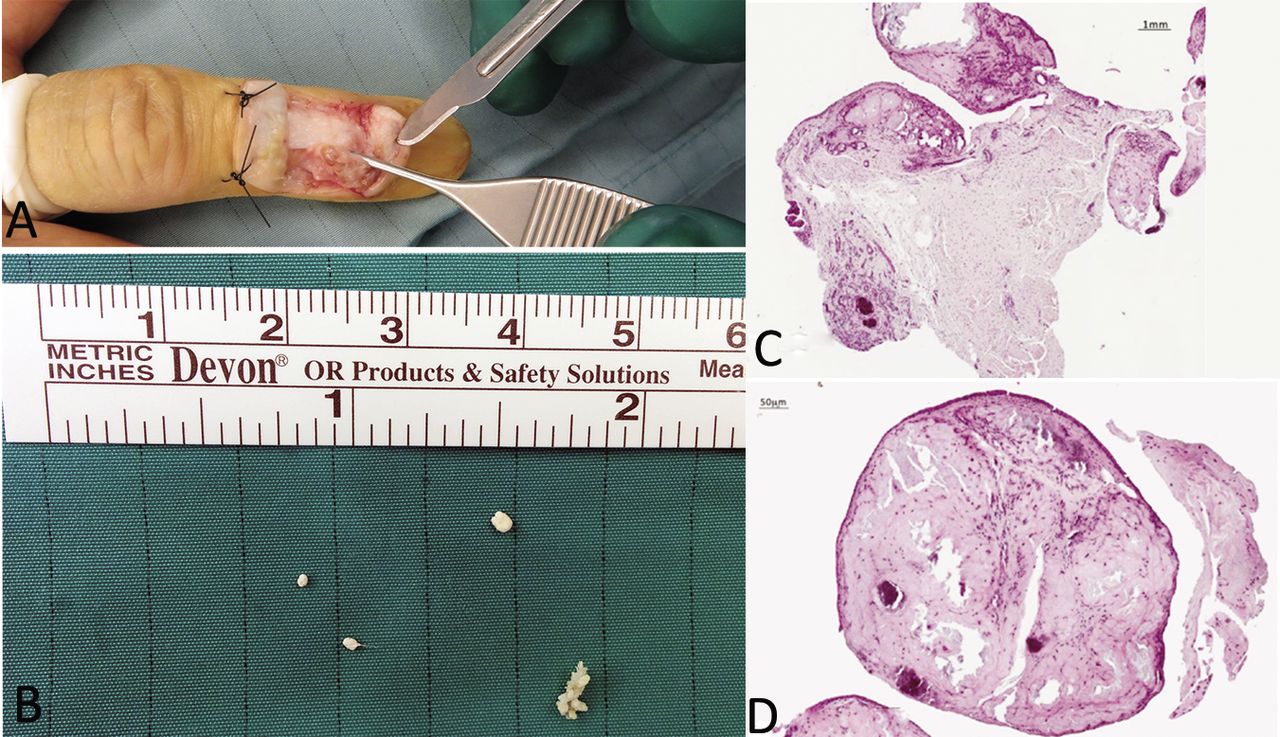
A: Gross view of surgical dissection. B: The loose bodies remove from the distal interphalangeal joint were firm, smooth, yellowish with homogeneous cut surfaces. C and D: Anatomopathological evaluation showed typical round cellular islands of cartilage in fibrous tissue, chondrocytes forming nests of cells, a distinctive aspect of synovial chondromatosis (hematoxyllin-eosin; magnification C: 20×, D:40×). No malignancy was found in this setting.

Figure 2.
  • Download figure
  • Open in new tab
  • Download powerpoint
Figure 2.

Radiograph performed after the surgical treatment. After removal of loose bodies and the reduction of the volar luxation of the phalanx, arthrodesis of distal interphalangeal joint by two Kirschner wires was carried out.

The patient reported a worsening of functional deficits with increased pain and light touch discomfort. She was therefore advised to undergo surgical exploration, with a diagnoses of erosive osteoarthritis of the hand.

DIP exploration revealed multiple firm smooth yellowish nodules, strongly suggesting a rare case of synovial chondromatosis, which were excised and sent for pathological examination (Figure 1).

Figure 3.
  • Download figure
  • Open in new tab
  • Download powerpoint
Figure 3.

Radiographs performed 30 days after surgery showed initial bone healing.

Therefore, given the state of articular surfaces, in order to maintain finger functionality, surgical arthrodesis of DIP by two Kirschner wires was performed (Figure 2). A splinted cast was applied for 30 days, removed only for physical rehabilitation. Four days after surgery, physical therapy to maintain the range of motion of the proximal interphalangeal joint and metacarpophalangeal joint of the right middle finger was initiated.

At one-month follow-up, X-rays showed a healing callus (Figure 3), and the splinted cast and Kirschner wires were removed.

Histological studies revealed well-circumscribed nodules of cartilage and bone. The cartilage was of moderate cellularity, with varying degrees of ossification, which was consistent with synovial chondromatosis (Figure 1C and D).

Milgram described three separate phases in primary synovial chondromatosis: Stage 1i: Active intrasynovial disease with no free loose bodies; stage 1: transitional lesion with osteochondral nodules in the synovial membrane and osteochondral bodies lying free within the joint cavity; stage 3: multiple free osteochondral bodies with now quiescent intrasynovial disease (19). We classified our patient as being in stage 2 by Milgram's classification.

Figure 4.
  • Download figure
  • Open in new tab
  • Download powerpoint
Figure 4.

A: Finger presentation 2 years after surgery: there were no signs of inflammation. B: X-Ray performed 2 years after surgery showed no signs of recurrence.

No recurrence was observed after 2-year follow-up (Figure 4).

Discussion

Primary synovial chondromatosis consists of cartilaginous metaplasia of the synovium, which leads to the production of intra-articular and periarticular osteocartilaginous bodies. Distinction of primary synovial chondromatosis from the more common secondary synovial chondromatosis, which consists of free articular cartilage fragments resulting from degenerative disease or trauma, is not always simple.

As previously stated, this condition rarely involves the upper extremity. Literature reveals that primary articular synovial chondromatosis is exceedingly rare in the DIP joint, with only three cases reported in literature (20-22).

Because of its low prevalence, and inconstant symptoms, diagnosis can often be delayed. The differential diagnosis includes chronic infection, trauma, erosive osteoarthrosis, and autoimmune disease such as systemic lupus erythematosus, rheumatoid arthritis and psoriatic arthritis that were excluded through blood analysis in this case.

Despite the fact that malignant transformation into chondrosarcoma is considered extremely rare, complete excision of the lesion is commonly accepted. Usually pain and other symptoms are relieved by the evacuation of the loose bodies. Synoviectomy is also recommended in literature in order to reduce symptoms (3), even though whether it prevents recurrence is still controversial.

The difficulty in determining the most appropriate treatment in synovial chondromatosis is due to the low incidence of the disease, which precludes carrying out randomized trials. For cases in the DIP joint, there is good reason to proceed to total synoviectomy and arthrodesis immediately (22, 23).

Long-term follow-up is indicated for all patients because recurrence is not common but can occur (23). Moreover, malignant transformation into chondrosarcoma is considered extremely rare; in the literature, a relative increased risk of developing chondrosarcoma was reported in a series of 53 cases of synovial chondromatosis (23).

In conclusion, synovial chondromatosis is a rare disease, and its localization in the hand is uncommon. Proper differential diagnosis is crucial in order to recognized and treat it correctly.

Footnotes

  • Authors' Contributions

    PPP and AM perform the operation. LS, FDF and AG wrote the article. AG and MR supervised and correct the article.

  • All Authors contributed equally to this work.

  • This article is freely accessible online.

  • Conflicts of Interest

    No pharmaceutical industry or outside support was used for this study.

    The Authors report no conflicts of interest. No funding was received for this work.

  • Received May 1, 2019.
  • Revision received May 22, 2019.
  • Accepted May 23, 2019.
  • Copyright© 2019, International Institute of Anticancer Research (Dr. George J. Delinasios), All rights reserved

References

  1. ↵
    1. Ho YY,
    2. Choueka J
    : Synoval chondromatosis of the upper extremity. J Hand Surg 38(4): 804-810, 2013. PMID: 23474166. DOI: 10.1016/j.jhsa.2013.01.041
    OpenUrlCrossRef
  2. ↵
    1. Wong SH-M,
    2. Salama S,
    3. Thoma A
    : Synovial chondromatosis of the hand: Three case reports and literature review. Can J Plast Surg 11(1): 47-52, 2003. PMID: 24115851.
    OpenUrlPubMed
  3. ↵
    1. Maurice H,
    2. Crone M,
    3. Watt I
    : Synovial chondromatosis. J Bone Joint Surg 70(5): 807-811, 1988. PMID: 3192585.
    OpenUrl
  4. ↵
    1. Kumar N,
    2. Mukhopadhaya J,
    3. Anand OJ
    : Synovial chondromatosis of distal radioulna joint with features of lytic lesion in a 29 years male: A case report and review of literature. J Sports Med Doping Stud 6: 174, 2016. DOI: 10.4172/2161-0673.1000174
    OpenUrl
  5. ↵
    1. Reed SC,
    2. Wright CS
    : Synovial chondromatosis of the metacarpophalangeal joint: case report and review of the literature. Can J Surg 39(5): 407-409, 1996. PMID: 8857991.
    OpenUrlPubMed
    1. Hettiaratchy SP,
    2. Nanchahal J
    : Synovial chondromatosis of the metacarpophalangeal joint. J Hand Surg 27(1): 104-106, 2002. PMID: 11895357. DOI: 10.1054/jhsb.2001.0677
    OpenUrlPubMed
    1. Ozcelik IB,
    2. Kuvat SV,
    3. Mersa B,
    4. Pilancı O
    : Synovial chondromatosis of the metacarpophalangeal joint of the ring finger. Acta Orthop Traumatol Turc 44(4): 337-339, 2010. PMID: 21252612. DOI: 10.3944/AOTT.2010.2324
    OpenUrlCrossRefPubMed
    1. Tominaga A,
    2. Takenaka S,
    3. Murase T,
    4. Hashimoto N,
    5. Naka N,
    6. Yoshikawa H
    : Synovial chondromatosis of the metacarpophalangeal joint: A case report and literature review. Hand Surg 17(03): 395-398, 2012. PMID: 23061954. DOI: 10.1142/S0218810412720409
    OpenUrlPubMed
  6. ↵
    1. Warne BA,
    2. Tigrani DY,
    3. Ward CM
    : Metacarpophalangeal joint synovial osteochondromatosis: A case report. Iowa Orthop J 28: 91-93, 2008. PMID: 19223957.
    OpenUrlPubMed
  7. ↵
    1. Sano K,
    2. Hashimoto T,
    3. Kimura K,
    4. Ozeki S
    : Articular synovial chondromatosis of the finger. J Plast Surg Hand Surg 48(5): 347-349, 2014. PMID: 23596991. DOI:10.3109/2000656 X.2013. 788308
    OpenUrlPubMed
    1. Takami H,
    2. Takahashi S,
    3. Ando M
    : Synovial chondromatosis of the proximal interphalangeal joint of a finger. J Hand Surg 19(5): 794-796, 1994. PMID: 7806802. DOI: 10.1016/0363-5023(94)90185-6
    OpenUrlPubMed
    1. Kamath BJ,
    2. Bhardwaj P,
    3. Shriharsha K,
    4. Sharma C
    : Synovial chondromatosis of the proximal interphalan-geal joint. J Hand Surg 32(1): 108-108, 2007. PMID: 17125894. DOI: 10.1016/j.jhsb.2006.10.003
    OpenUrlPubMed
    1. Spiers JD,
    2. Wijeratna MD,
    3. Jones JW
    : Synovial chondromatosis affecting a digital proximal interphalangeal joint. Hand Surg 19(01): 127-129, 2014. PMID: 24641756. DOI: 10.1142/S0218810414720101
    OpenUrlPubMed
  8. ↵
    1. Kumar A,
    2. Thomas AP
    : Recurrent synovial chondromatosis of the index finger: Case report and literature review. Hand Surg 5(02): 181-183, 2000. PMID: 11301515.
    OpenUrlPubMed
  9. ↵
    1. Lewis MM,
    2. Marshall JL,
    3. Mirra JM
    : Synovial chondromatosis of the thumb: A case report and review of the literature. JBJS 56(1): 180-183, 1974. PMID: 4812161.
    OpenUrlPubMed
    1. Malhotra R,
    2. Gaur S,
    3. Dave PK,
    4. Dinda AK
    : Synovial chondromatosis of the interphalangeal joint of the thumb: A case report. J Hand Surg 19(3): 460-461,1994. PMID: 8056975. DOI: 10.1016/0363-5023(94)90063-9
    OpenUrlCrossRef
    1. Gottschalk HP,
    2. Newbury R,
    3. Wallace CD
    : Synovial chondromatosis in a child's thumb: a case report and review of the literature. Hand 7(1): 98-102, 2012. PMID: 23450976. DOI:10.1007/s11552-011-9376-y
    OpenUrlPubMed
  10. ↵
    1. Muramatsu K,
    2. Hashimoto T,
    3. Tominaga Y,
    4. Taguchi T
    : Large synovial osteochondromatosis arising from the interphalangeal joint of the thumb: A case report and review of the literature. Anticancer Res 34(2): 1057-1060, 2014. PMID: 24511055.
    OpenUrlAbstract/FREE Full Text
  11. ↵
    1. Milgram JW
    : Synovial chondromatosis a hystopatological study of thirty cases. J Bone Joint Surg Am 59(6): 792-801,1977. PMID: 908703.
    OpenUrlAbstract/FREE Full Text
  12. ↵
    1. Harvey FJ,
    2. Negrine J
    : Synovial chondromatosis in the distal interphalangeal joint. J Hand Surg 15(1): 102-105,1990. PMID: 2299147.
    OpenUrl
    1. Craft RO,
    2. Smith AA,
    3. Duncan SFM
    : Recurrent synovial chondromatosis of the distal interphalangeal joint: Case report. J Hand Surg 34(2): 301-303, 2009. PMID: 19181231. DOI: 10.1016/j.jhsa.2008.10.020
    OpenUrl
  13. ↵
    1. Arnaud JP,
    2. Giroud P,
    3. Arnaud M,
    4. Pecout C
    : Osteochondromatosis of distal interphalangeal articulation. Ann Chir Main 6(2): 144-146, 1987. PMID: 3426319.
    OpenUrlPubMed
  14. ↵
    1. Apte SS,
    2. Athanasou NA
    : An immunohistological study of cartilage and synovium in primary synovial chondromatosis. J Pathol 166(3): 277-281, 1992. DOI: 10.1002/path.1711660310
    OpenUrlCrossRefPubMed
PreviousNext
Back to top

In this issue

Anticancer Research
Vol. 39, Issue 6
June 2019
  • Table of Contents
  • Table of Contents (PDF)
  • Index by author
  • Back Matter (PDF)
  • Ed Board (PDF)
  • Front Matter (PDF)
Print
Download PDF
Article Alerts
Sign In to Email Alerts with your Email Address
Email Article

Thank you for your interest in spreading the word on Anticancer Research.

NOTE: We only request your email address so that the person you are recommending the page to knows that you wanted them to see it, and that it is not junk mail. We do not capture any email address.

Enter multiple addresses on separate lines or separate them with commas.
A Rare Case of Distal Interphalangeal Chondromatosis in the Middle Finger: Case Report With Review of Literature
(Your Name) has sent you a message from Anticancer Research
(Your Name) thought you would like to see the Anticancer Research web site.
CAPTCHA
This question is for testing whether or not you are a human visitor and to prevent automated spam submissions.
1 + 0 =
Solve this simple math problem and enter the result. E.g. for 1+3, enter 4.
Citation Tools
A Rare Case of Distal Interphalangeal Chondromatosis in the Middle Finger: Case Report With Review of Literature
LETIZIA SENESI, PIER PAOLO PANGRAZI, ANDREA MARCHESINI, FRANCESCO DE FRANCESCO, ANTONIO GIORDANO, ANTONIO GIGANTE, MICHELE RICCIO
Anticancer Research Jun 2019, 39 (6) 2951-2955; DOI: 10.21873/anticanres.13425

Citation Manager Formats

  • BibTeX
  • Bookends
  • EasyBib
  • EndNote (tagged)
  • EndNote 8 (xml)
  • Medlars
  • Mendeley
  • Papers
  • RefWorks Tagged
  • Ref Manager
  • RIS
  • Zotero
Reprints and Permissions
Share
A Rare Case of Distal Interphalangeal Chondromatosis in the Middle Finger: Case Report With Review of Literature
LETIZIA SENESI, PIER PAOLO PANGRAZI, ANDREA MARCHESINI, FRANCESCO DE FRANCESCO, ANTONIO GIORDANO, ANTONIO GIGANTE, MICHELE RICCIO
Anticancer Research Jun 2019, 39 (6) 2951-2955; DOI: 10.21873/anticanres.13425
Twitter logo Facebook logo Mendeley logo
  • Tweet Widget
  • Facebook Like
  • Google Plus One

Jump to section

  • Article
    • Abstract
    • Case Report
    • Discussion
    • Footnotes
    • References
  • Figures & Data
  • Info & Metrics
  • PDF

Related Articles

Cited By...

  • No citing articles found.
  • Google Scholar

More in this TOC Section

  • Feasibility of Minimally Invasive Surgery for Locally Advanced Gastric Cancer After Neoadjuvant Chemotherapy: A Four-arm Comparative Study
  • Prior Radiotherapy Improves Progression-free Survival in Patients With Advanced Hepatocellular Carcinoma Treated With Tremelimumab–Durvalumab
  • Optimizing Biopsy Decisions in PI-RADS 3-4 Lesions: Integrating PSA-derived Biomarkers to Reduce Unnecessary Procedures
Show more Clinical Studies

Keywords

  • Distal interphalangeal joint
  • hand
  • synovial chondromatosis
  • case report
Anticancer Research

© 2026 Anticancer Research

Powered by HighWire