
Main menu

  • Home
  • Current Issue
  • Archive
  • Info for
    • Authors
    • Editorial Policies
    • Subscribers
    • Advertisers
    • Editorial Board
    • Special Issues
  • Journal Metrics
  • Other Publications
    • In Vivo
    • Cancer Genomics & Proteomics
    • Cancer Diagnosis & Prognosis
  • More
    • IIAR
    • Conferences
    • 2008 Nobel Laureates
  • About Us
    • General Policy
    • Contact
  • Other Publications
    • Anticancer Research
    • In Vivo
    • Cancer Genomics & Proteomics

User menu

  • Register
  • Subscribe
  • My alerts
  • Log in
  • My Cart

Search

  • Advanced search
Anticancer Research
  • Other Publications
    • Anticancer Research
    • In Vivo
    • Cancer Genomics & Proteomics
  • Register
  • Subscribe
  • My alerts
  • Log in
  • My Cart
Anticancer Research

Advanced Search

  • Home
  • Current Issue
  • Archive
  • Info for
    • Authors
    • Editorial Policies
    • Subscribers
    • Advertisers
    • Editorial Board
    • Special Issues
  • Journal Metrics
  • Other Publications
    • In Vivo
    • Cancer Genomics & Proteomics
    • Cancer Diagnosis & Prognosis
  • More
    • IIAR
    • Conferences
    • 2008 Nobel Laureates
  • About Us
    • General Policy
    • Contact
  • Visit us on Facebook
  • Follow us on Linkedin
Research ArticleClinical Studies

Early Recurrence and Cancer Death After Trimodal Therapy for Esophageal Squamous Cell Carcinoma

YOICHI HAMAI, MANABU EMI, YUTA IBUKI, YUJI MURAKAMI, IKUNO NISHIBUCHI, YASUSHI NAGATA, TAKAOKI FURUKAWA, TOMOAKI KUROKAWA, MANATO OHSAWA and MORIHITO OKADA
Anticancer Research March 2019, 39 (3) 1433-1440; DOI: https://doi.org/10.21873/anticanres.13259
YOICHI HAMAI
1Department of Surgical Oncology, Research Institute for Radiation Biology and Medicine, Hiroshima University, Hiroshima, Japan
  • Find this author on Google Scholar
  • Find this author on PubMed
  • Search for this author on this site
  • For correspondence: yyhamai{at}hotmail.com
MANABU EMI
1Department of Surgical Oncology, Research Institute for Radiation Biology and Medicine, Hiroshima University, Hiroshima, Japan
  • Find this author on Google Scholar
  • Find this author on PubMed
  • Search for this author on this site
YUTA IBUKI
1Department of Surgical Oncology, Research Institute for Radiation Biology and Medicine, Hiroshima University, Hiroshima, Japan
  • Find this author on Google Scholar
  • Find this author on PubMed
  • Search for this author on this site
YUJI MURAKAMI
2Department of Radiation Oncology, Institute of Biomedical and Health Sciences, Hiroshima University, Hiroshima, Japan
  • Find this author on Google Scholar
  • Find this author on PubMed
  • Search for this author on this site
IKUNO NISHIBUCHI
2Department of Radiation Oncology, Institute of Biomedical and Health Sciences, Hiroshima University, Hiroshima, Japan
  • Find this author on Google Scholar
  • Find this author on PubMed
  • Search for this author on this site
YASUSHI NAGATA
2Department of Radiation Oncology, Institute of Biomedical and Health Sciences, Hiroshima University, Hiroshima, Japan
  • Find this author on Google Scholar
  • Find this author on PubMed
  • Search for this author on this site
TAKAOKI FURUKAWA
1Department of Surgical Oncology, Research Institute for Radiation Biology and Medicine, Hiroshima University, Hiroshima, Japan
  • Find this author on Google Scholar
  • Find this author on PubMed
  • Search for this author on this site
TOMOAKI KUROKAWA
1Department of Surgical Oncology, Research Institute for Radiation Biology and Medicine, Hiroshima University, Hiroshima, Japan
  • Find this author on Google Scholar
  • Find this author on PubMed
  • Search for this author on this site
MANATO OHSAWA
1Department of Surgical Oncology, Research Institute for Radiation Biology and Medicine, Hiroshima University, Hiroshima, Japan
  • Find this author on Google Scholar
  • Find this author on PubMed
  • Search for this author on this site
MORIHITO OKADA
1Department of Surgical Oncology, Research Institute for Radiation Biology and Medicine, Hiroshima University, Hiroshima, Japan
  • Find this author on Google Scholar
  • Find this author on PubMed
  • Search for this author on this site
  • Article
  • Figures & Data
  • Info & Metrics
  • PDF
Loading

Article Figures & Data

Figures

  • Tables
  • Figure 1.
    • Download figure
    • Open in new tab
    • Download powerpoint
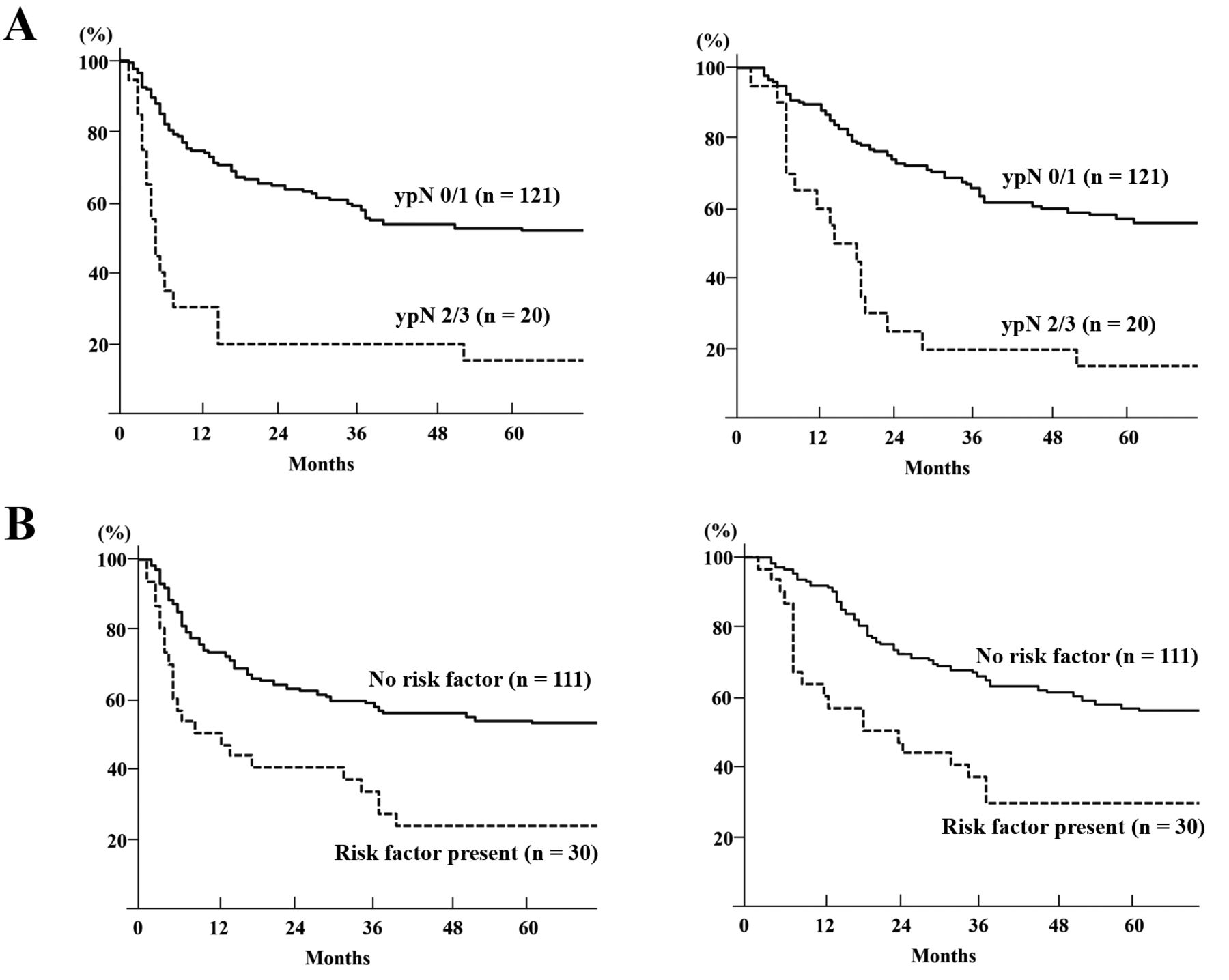
    Figure 1.

    Recurrence-free (RFS; left panel) and overall (OS; right panel) survival of patients with esophageal squamous cell carcinoma after trimodal therapy according to the presence of risk factors [pathological nodal staging (ypN), postoperative complications, and venous invasion] associated with early recurrence and early cancer death. A: Survival rates of patients according to ypN as a risk factor for early recurrence (p<0.0001). B: Survival rates of patients with Clavien–Dindo grade ≥3b postoperative complications with/without venous invasion compared with those with neither of them as risk factors for early cancer death (RFS: p=0.0004; OS: p=0.001).
Tables

  • Figures
  • Table I.
  • Table II.
  • Table III.
  • Table IV.
PreviousNext
Back to top

In this issue

Anticancer Research
Vol. 39, Issue 3
March 2019
  • Table of Contents
  • Index by author
  • Back Matter (PDF)
  • Ed Board (PDF)
  • Front Matter (PDF)
Print
Download PDF
Article Alerts
Sign In to Email Alerts with your Email Address
Email Article

Thank you for your interest in spreading the word on Anticancer Research.

NOTE: We only request your email address so that the person you are recommending the page to knows that you wanted them to see it, and that it is not junk mail. We do not capture any email address.

Enter multiple addresses on separate lines or separate them with commas.
Early Recurrence and Cancer Death After Trimodal Therapy for Esophageal Squamous Cell Carcinoma
(Your Name) has sent you a message from Anticancer Research
(Your Name) thought you would like to see the Anticancer Research web site.
CAPTCHA
This question is for testing whether or not you are a human visitor and to prevent automated spam submissions.
2 + 15 =
Solve this simple math problem and enter the result. E.g. for 1+3, enter 4.
Citation Tools
Early Recurrence and Cancer Death After Trimodal Therapy for Esophageal Squamous Cell Carcinoma
YOICHI HAMAI, MANABU EMI, YUTA IBUKI, YUJI MURAKAMI, IKUNO NISHIBUCHI, YASUSHI NAGATA, TAKAOKI FURUKAWA, TOMOAKI KUROKAWA, MANATO OHSAWA, MORIHITO OKADA
Anticancer Research Mar 2019, 39 (3) 1433-1440; DOI: 10.21873/anticanres.13259

Citation Manager Formats

  • BibTeX
  • Bookends
  • EasyBib
  • EndNote (tagged)
  • EndNote 8 (xml)
  • Medlars
  • Mendeley
  • Papers
  • RefWorks Tagged
  • Ref Manager
  • RIS
  • Zotero
Reprints and Permissions
Share
Early Recurrence and Cancer Death After Trimodal Therapy for Esophageal Squamous Cell Carcinoma
YOICHI HAMAI, MANABU EMI, YUTA IBUKI, YUJI MURAKAMI, IKUNO NISHIBUCHI, YASUSHI NAGATA, TAKAOKI FURUKAWA, TOMOAKI KUROKAWA, MANATO OHSAWA, MORIHITO OKADA
Anticancer Research Mar 2019, 39 (3) 1433-1440; DOI: 10.21873/anticanres.13259
Twitter logo Facebook logo Mendeley logo
  • Tweet Widget
  • Facebook Like
  • Google Plus One

Jump to section

  • Article
    • Abstract
    • Patients and Methods
    • Results
    • Discussion
    • Footnotes
    • References
  • Figures & Data
  • Info & Metrics
  • PDF

Related Articles

Cited By...

  • Correlation Between Tumor Uptake on FDG-PET and Malignant Features in Esophageal Squamous Cell Carcinoma After Neoadjuvant Chemotherapy Followed by Surgery
  • Neutrophil-to-Lymphocyte Ratio as a Predictor of Postoperative Recurrence and Prognosis in Oesophageal Squamous Cell Carcinoma
  • Comparison of Open and Thoracoscopic Esophagectomy in Patients With Locally Advanced Esophageal Squamous Cell Carcinoma After Neoadjuvant Therapy
  • Risk Factors for Recurrence in Esophageal Squamous Cell Carcinoma Without Pathological Complete Response After Trimodal Therapy
  • A Scoring Tool to Estimate the Survival of Elderly Patients With Brain Metastases from Esophageal Cancer Receiving Whole-brain Irradiation
  • Google Scholar

More in this TOC Section

  • Pembrolizumab and Quality of Life in Recurrent or Metastatic Head and Neck Cancer
  • Pretreatment Tumor Growth Rate and Clinical Outcomes in Advanced Non–small Cell Lung Cancer
  • Standard Clinical Characteristics Fail to Predict Mild Chemotherapy-induced Peripheral Neuropathy in Breast Cancer Patients
Show more Clinical Studies

Keywords

  • chemoradiation
  • Complication
  • esophagus
  • lymph node
  • vascular invasion
Anticancer Research

© 2026 Anticancer Research

Powered by HighWire