Main menu

  • Home
  • Current Issue
  • Archive
  • Info for
    • Authors
    • Editorial Policies
    • Subscribers
    • Advertisers
    • Editorial Board
    • Special Issues
  • Journal Metrics
  • Other Publications
    • In Vivo
    • Cancer Genomics & Proteomics
    • Cancer Diagnosis & Prognosis
  • More
    • IIAR
    • Conferences
    • 2008 Nobel Laureates
  • About Us
    • General Policy
    • Contact
  • Other Publications
    • Anticancer Research
    • In Vivo
    • Cancer Genomics & Proteomics

User menu

  • Register
  • Subscribe
  • My alerts
  • Log in
  • My Cart

Search

  • Advanced search
Anticancer Research
  • Other Publications
    • Anticancer Research
    • In Vivo
    • Cancer Genomics & Proteomics
  • Register
  • Subscribe
  • My alerts
  • Log in
  • My Cart
Anticancer Research

Advanced Search

  • Home
  • Current Issue
  • Archive
  • Info for
    • Authors
    • Editorial Policies
    • Subscribers
    • Advertisers
    • Editorial Board
    • Special Issues
  • Journal Metrics
  • Other Publications
    • In Vivo
    • Cancer Genomics & Proteomics
    • Cancer Diagnosis & Prognosis
  • More
    • IIAR
    • Conferences
    • 2008 Nobel Laureates
  • About Us
    • General Policy
    • Contact
  • Visit us on Facebook
  • Follow us on Linkedin
Research ArticleExperimental Studies

The Synthetic Cannabinoid WIN 55,212-2 Elicits Death in Human Cancer Cell Lines

LEONIE MÜLLER, ARLO RADTKE, JENNIFER DECKER, MICHAEL KOCH and GAZANFER BELGE
Anticancer Research November 2017, 37 (11) 6341-6345;
LEONIE MÜLLER
1Faculty of Biology and Chemistry, University of Bremen, Bremen, Germany
2Department of Neuropharmacology – Brain Research Institute, University of Bremen, Bremen, Germany
  • Find this author on Google Scholar
  • Find this author on PubMed
  • Search for this author on this site
ARLO RADTKE
1Faculty of Biology and Chemistry, University of Bremen, Bremen, Germany
  • Find this author on Google Scholar
  • Find this author on PubMed
  • Search for this author on this site
JENNIFER DECKER
1Faculty of Biology and Chemistry, University of Bremen, Bremen, Germany
2Department of Neuropharmacology – Brain Research Institute, University of Bremen, Bremen, Germany
  • Find this author on Google Scholar
  • Find this author on PubMed
  • Search for this author on this site
MICHAEL KOCH
2Department of Neuropharmacology – Brain Research Institute, University of Bremen, Bremen, Germany
  • Find this author on Google Scholar
  • Find this author on PubMed
  • Search for this author on this site
GAZANFER BELGE
1Faculty of Biology and Chemistry, University of Bremen, Bremen, Germany
  • Find this author on Google Scholar
  • Find this author on PubMed
  • Search for this author on this site
  • For correspondence: belge{at}uni-bremen.de
  • Article
  • Figures & Data
  • Info & Metrics
  • PDF
Loading

Article Figures & Data

Figures

  • Figure 1.
    • Download figure
    • Open in new tab
    • Download powerpoint
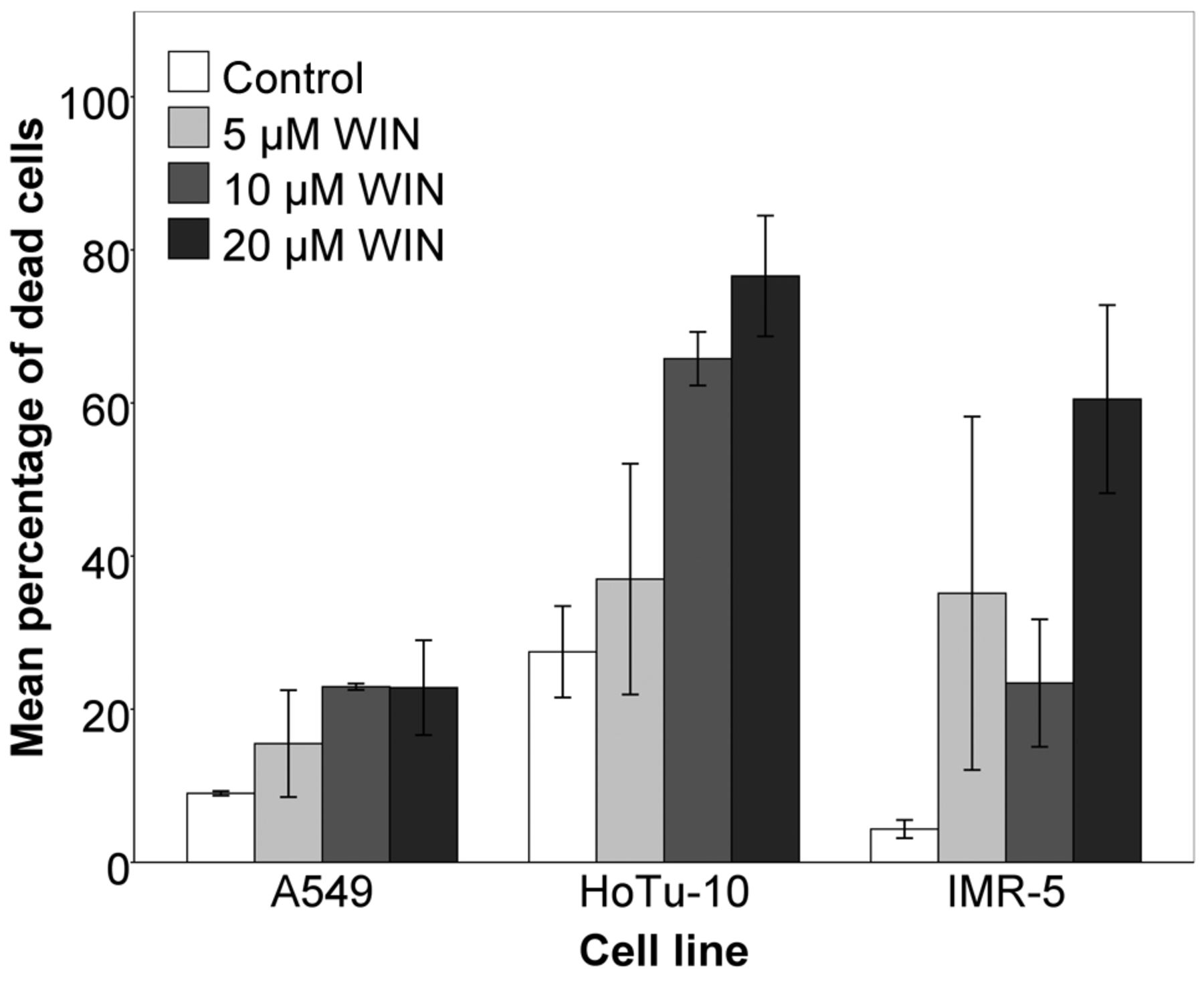
    Figure 1.

    Percentage of dead cells after treatment of A549, HoTu-10 and IMR-5 cells with different doses of (R)-(+)-WIN 55,212-2 mesylate salt (WIN). Data are the mean±standard deviation (n=3).

  • Figure 2.
    • Download figure
    • Open in new tab
    • Download powerpoint
    Figure 2.

    Boxplots of the percentage of dead A549, HoTu-10 or IMR-5 cells after treatment with (R)-(+)-WIN 55,212-2 mesylate salt (WIN). All n=9, except n=10 for HoTu-10 cells at 20 μM concentration and n=11 for IMR-5 cells at 10 μM. Significant differences between subgroups at *p<0.05; **p<0.01; ***p<0.001.

  • Figure 3.
    • Download figure
    • Open in new tab
    • Download powerpoint
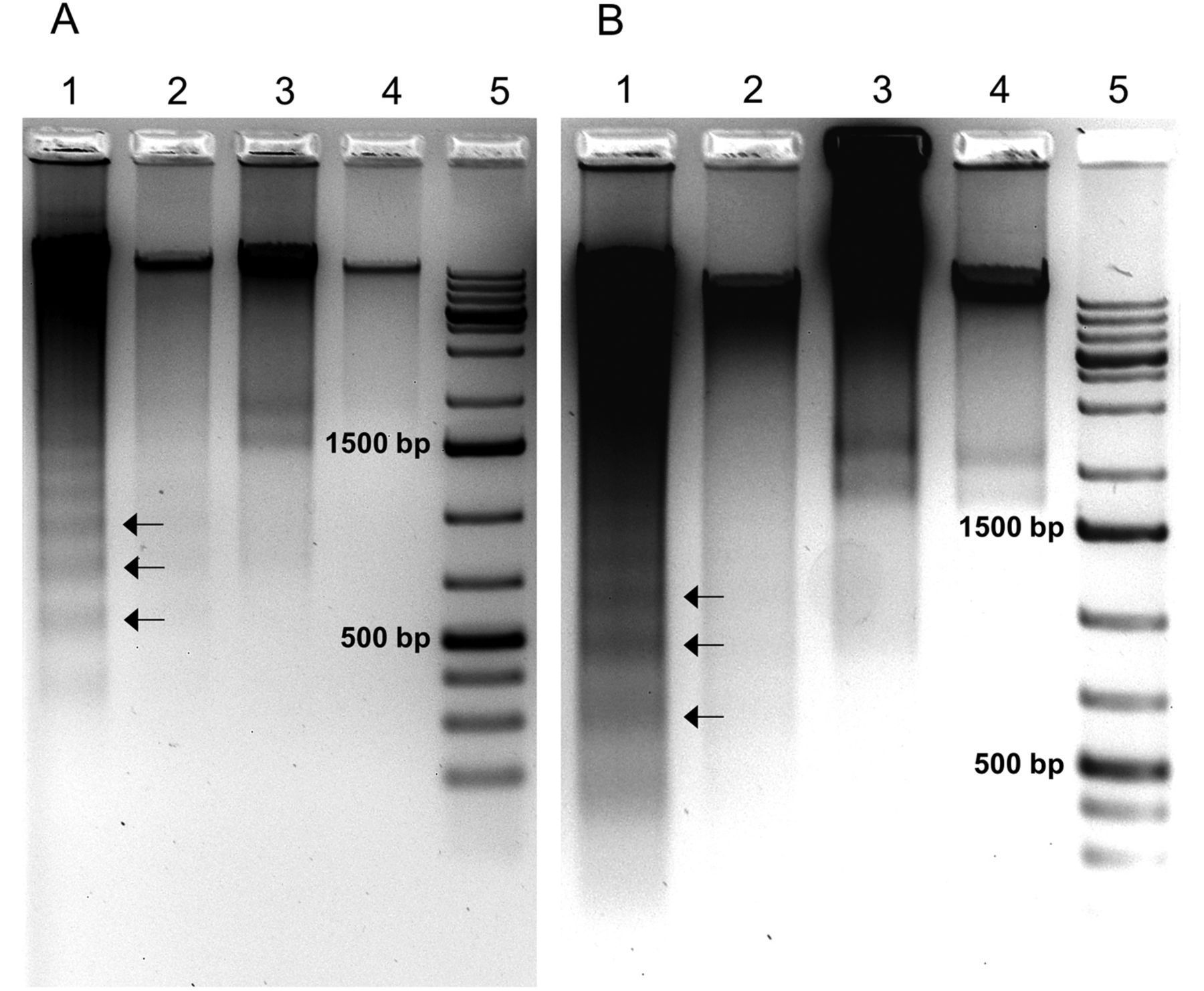
    Figure 3.

    Agarose gel electrophoresis of DNA from A549 (A) and HoTu-10 (B) cells treated with 20 μM (R)-(+)-WIN 55,212-2 mesylate salt (WIN) and the according controls. In both parts, 6 μg DNA from treated cells (lane 1), 1 μg DNA from treated cells (lane 2), 6 μg DNA from control cells (lane 3), 1 μg DNA from control cells (lane 4) and a molecular weight marker (lane 5) were used. Arrows indicate the ladder pattern. No DNA-ladder pattern was visible on treatment of I MR-5 cells with WIN (data not shown).

PreviousNext
Back to top

In this issue

Anticancer Research
Vol. 37, Issue 11
November 2017
  • Table of Contents
  • Index by author
  • Back Matter (PDF)
  • Ed Board (PDF)
  • Front Matter (PDF)
Print
Download PDF
Article Alerts
Sign In to Email Alerts with your Email Address
Email Article

Thank you for your interest in spreading the word on Anticancer Research.

NOTE: We only request your email address so that the person you are recommending the page to knows that you wanted them to see it, and that it is not junk mail. We do not capture any email address.

Enter multiple addresses on separate lines or separate them with commas.
The Synthetic Cannabinoid WIN 55,212-2 Elicits Death in Human Cancer Cell Lines
(Your Name) has sent you a message from Anticancer Research
(Your Name) thought you would like to see the Anticancer Research web site.
CAPTCHA
This question is for testing whether or not you are a human visitor and to prevent automated spam submissions.
8 + 1 =
Solve this simple math problem and enter the result. E.g. for 1+3, enter 4.
Citation Tools
The Synthetic Cannabinoid WIN 55,212-2 Elicits Death in Human Cancer Cell Lines
LEONIE MÜLLER, ARLO RADTKE, JENNIFER DECKER, MICHAEL KOCH, GAZANFER BELGE
Anticancer Research Nov 2017, 37 (11) 6341-6345;

Citation Manager Formats

  • BibTeX
  • Bookends
  • EasyBib
  • EndNote (tagged)
  • EndNote 8 (xml)
  • Medlars
  • Mendeley
  • Papers
  • RefWorks Tagged
  • Ref Manager
  • RIS
  • Zotero
Reprints and Permissions
Share
The Synthetic Cannabinoid WIN 55,212-2 Elicits Death in Human Cancer Cell Lines
LEONIE MÜLLER, ARLO RADTKE, JENNIFER DECKER, MICHAEL KOCH, GAZANFER BELGE
Anticancer Research Nov 2017, 37 (11) 6341-6345;
Twitter logo Facebook logo Mendeley logo
  • Tweet Widget
  • Facebook Like
  • Google Plus One

Jump to section

  • Article
    • Abstract
    • Materials and Methods
    • Results
    • Discussion
    • Footnotes
    • References
  • Figures & Data
  • Info & Metrics
  • PDF

Related Articles

Cited By...

  • The Synthetic Cannabinoid WIN55,212-2 Can Disrupt the Golgi Apparatus Independent of Cannabinoid Receptor-1
  • Report of Objective Clinical Responses of Cancer Patients to Pharmaceutical-grade Synthetic Cannabidiol
  • Google Scholar

More in this TOC Section

  • Ginsenoside Rh4 Induces Apoptosis Through ROS-Mediated Fas Signaling in Human Nasopharyngeal Carcinoma NPC/HK1 Cells
  • Genome-wide Analysis Highlights rs4671908 and rs2238431 as Predictors of Survival in Nasopharyngeal Carcinoma
  • Implications of the Cuproptosis Protein SLC31A1 for the Immune Microenvironment and Temozolomide Sensitivity in Glioblastoma
Show more Experimental Studies

Keywords

  • WIN 55,212-2
  • Lung cancer
  • Testicular cancer
  • Neuroblastoma
  • apoptosis
Anticancer Research

© 2026 Anticancer Research

Powered by HighWire