


Article Figures & Data
Figures
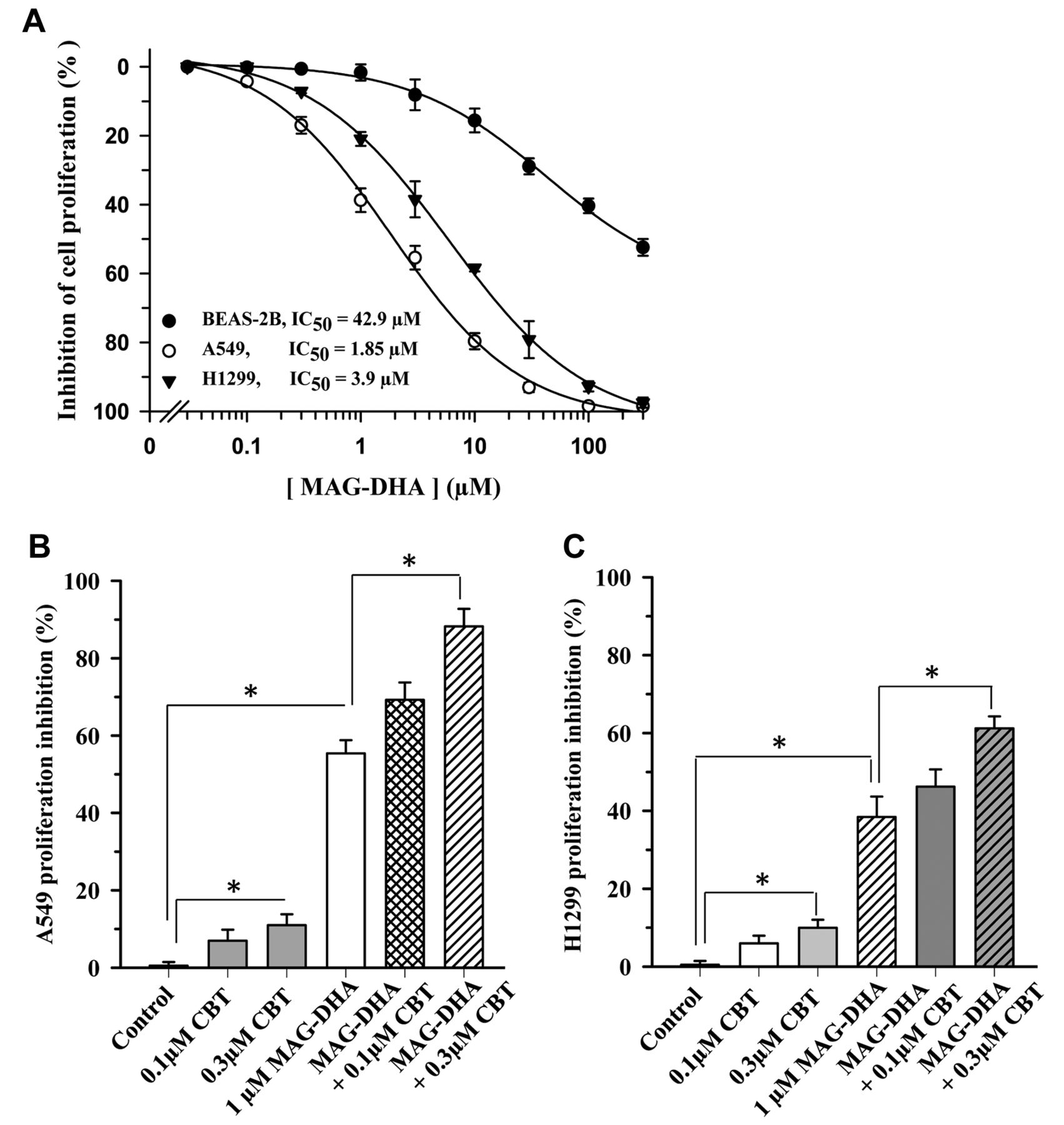
- Figure 1.
Effect of MAG-DHA and CBT treatments on proliferation of A549 and H1299 cells. A: Cumulative concentration response curves display the inhibitory effect of MAG-DHA on normal epithelial cells BEASE2B and in tumoral lung epithelial cells A549 and H1299, evaluated using the BrdU proliferation assay (n=8 for each experimental condition). B: Bar histogram displays the mean percent inhibition of cell proliferation of A549 control cells or treated with CBT (0.1 and 0.3 μM), MAG-DHA (1 μM,) and combined MAG-DHA (1 μM) plus CBT (0.1 μM) (n=8). C: Bar histogram displays the mean percent inhibition of cell proliferation of H1299 control cells or treated with CBT (0.1 and 0.3 μM), MAG-DHA (1 μM), and combined MAG-DHA (1 μM) plus CBT (0.1 μM) (n=6). Asterisc (*) indicates statistical significance p<0.05. MAG-DHA, Docosahexaenoic acid monoglyceride; CBT, carboplatin.
- Figure 2.
Effect of MAG-DHA treatment on the invasive abilities of A549 and H1299 cells. A: Representative images showing invasive cells (blue) in control and 1 μM MAG-DHA-treated A549 cells following cell invasion assay. B: Bar histogram displaying quantitative analysis of invasive cells quantified by spectrometry (OD 560nm) in control A549 cells, and after treatment with 0.1 μM CBT, 1 μM MAG-DHA, or combined 0.1 μM CBT plus 1 μM MAG-DHA (n=6 for each experimental condition). C: Representative images showing invasive cells (blue) in control and 1 μM MAG-DHA-treated H1299 cells following in vitro assay. D: Bar histogram displaying quantitative analysis of invasive cells in control and treated H1299 cells with 0.1 μM CBT, 1 μM MAG-DHA, or 0.1 μM CBT +1 μM MAG-DHA (n=6 for each experimental condition). Asterisc (*) indicates statistical significance p<0.05, MAG-DHA, Docosahexaenoic acid monoglyceride; CBT, carboplatin.
- Figure 3.
Effect of combined MAG-DHA and CBT treatments on EGFR and ERK phosphorylation and expression levels in A549 and H1299 cells lysates. A: Western blot analysis of A549 and H1299 cell lysates derived from control (1), CBT (2), MAG-DHA (3) and MAG-DPA+CBT (4)-treated cells using specific antibodies against the phosphorylated form of EGFR (P-EGFR) and total form of EGFR and β-actin protein detection. B: Quantitative analyses of EGFR density ratios. Staining densities of EGFR in A549 and H1299 cell lysates were expressed as a function of β-actin signals. (n=6, p<0.05). Each number 1-4 corresponds to a different experimental group. C: Western blot analysis of phosphorylated form of ERK1/2 (P-ERK) and total form of ERK1/2 protein detection in A549 and H1299 cells lysates derived from control (1), CBT (2), MAG-DHA (3) and MAG-DHA+CBT (4)-treated cells. D: Quantitative analyses of P-ERK density ratios. Staining densities in A549 and H1299 cells lysates were expressed as a function of total ERK signals (n=6). Each number 1-4 corresponds to a different experimental group. Asterisc (*) indicates statistical significance p<0.05. MAG-DHA, Docosahexaenoic acid monoglyceride; CBT, carboplatin; EGFR, epidermal growth factor receptor; ERK, extracellular signal-regulated kinase.
- Figure 4.
Effects of combined MAG-DHA and CBT treatment on tumor growth in the A549 xenograft nude mice model. A: Diagram showing the murine A549 xenograft protocol and treatments as a function of time (day). MAG-DHA was administered per os (618 mg/kg) daily following tumor formation of 50 mm3 (day 20). CBT was administered i.p. (15 mg/kg) every 7 days following tumor formation of 50 mm3. Mice received 6 injections of CBT until the end of MAG-DHA treatment (day 57). For MAG-DHA and MAG-DHA+CBT groups no treatment was given between days 58 and 102. B: Tumor growth (mm3) as a function of time (day) was measured after subcutaneous injection of 1×10⁶ A549 cells in control, CBT 15 mg/kg), MAG-DHA (618 mg/kg) and MAG-DHA+CBT-treated nude mice. The control and CBT mice were sacrificed following tumor formation of 500 mm3 on day 40, whereas the mice of MAG-DHA and MAG-DHA+CBT groups were sacrificed on day 103. Results represent the mean tumor volume±SEM (n=6 per group, p<0.05). C: Representative macroscopic images of tumor size derived from control, CBT, MAG-DHA and MAG-DHA+CBT-treated mice. MAG-DHA, Docosahexaenoic acid monoglyceride; CBT, carboplatin.
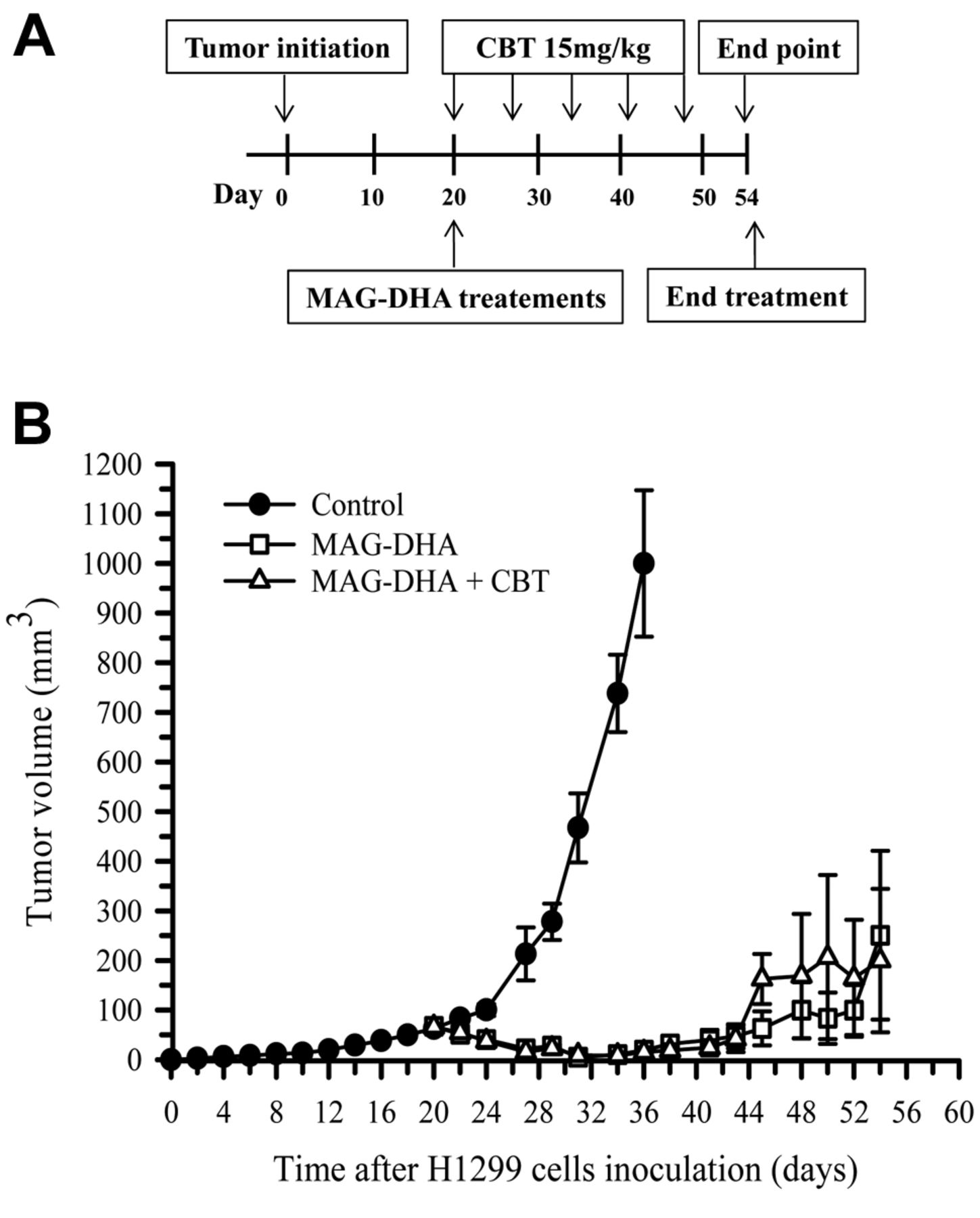
- Figure 5.
Effects of combined MAG-DHA and CBT treatment on tumor growth in the H1299 xenograft mice model. A: Diagram showing the H1299 xenograft protocol and treatments as a function of time (day). MAG-DHA was administered per os (618 mg/kg) daily following tumor formation of 50 mm3 (day 20). CBT was administered i.p. (15 mg/kg) every 7 days following tumor formation of 50 mm3. Mice received 5 doses of CBT until the end of MAG-DHA treatment (day 48). B: Tumor growth (mm3) as a function of time (day) was measured after subcutaneous injection of 1×10⁶ H1299 cells in control, MAG-DHA, and MAG-DHA+CBT-treated mice. The control mice were sacrificed following tumor formation of 1,000 mm3 on day 35, whereas the mice of MAG-DHA and MAG-DHA+CBT groups were sacrificed on day 54. Results represent the mean tumor volume±SEM (n=6 per group, p<0.05). MAG-DHA, Docosahexaenoic acid monoglyceride; CBT, carboplatin; EGFR, epidermal growth factor receptor; ERK, extracellular signal-regulated kinase.


In this issue


Jump to section
Related Articles
Cited By...
- No citing articles found.