Main menu

  • Home
  • Current Issue
  • Archive
  • Info for
    • Authors
    • Editorial Policies
    • Subscribers
    • Advertisers
    • Editorial Board
    • Special Issues
  • Journal Metrics
  • Other Publications
    • In Vivo
    • Cancer Genomics & Proteomics
    • Cancer Diagnosis & Prognosis
  • More
    • IIAR
    • Conferences
    • 2008 Nobel Laureates
  • About Us
    • General Policy
    • Contact
  • Other Publications
    • Anticancer Research
    • In Vivo
    • Cancer Genomics & Proteomics

User menu

  • Register
  • Subscribe
  • My alerts
  • Log in
  • My Cart

Search

  • Advanced search
Anticancer Research
  • Other Publications
    • Anticancer Research
    • In Vivo
    • Cancer Genomics & Proteomics
  • Register
  • Subscribe
  • My alerts
  • Log in
  • My Cart
Anticancer Research

Advanced Search

  • Home
  • Current Issue
  • Archive
  • Info for
    • Authors
    • Editorial Policies
    • Subscribers
    • Advertisers
    • Editorial Board
    • Special Issues
  • Journal Metrics
  • Other Publications
    • In Vivo
    • Cancer Genomics & Proteomics
    • Cancer Diagnosis & Prognosis
  • More
    • IIAR
    • Conferences
    • 2008 Nobel Laureates
  • About Us
    • General Policy
    • Contact
  • Visit us on Facebook
  • Follow us on Linkedin
Research ArticlePROCEEDINGS OF THE 19TH ANNUAL MEETING OF THE SOCIETY OF BIOTHERAPEUTIC APPROACHES, 5 December 2015 (Tokyo, Japan)

An Antitumor 2-Hydroxyarylidene-4-cyclopentene-1,3-Dione as a Protein Tyrosine Kinase Inhibitor: Interaction Between TX-1123 Derivatives and Src Kinase

KAZUTO OHKURA, YUKI KAWAGUCHI, YOHEI TATEMATSU, YOSHIHIRO UTO and HITOSHI HORI
Anticancer Research July 2016, 36 (7) 3645-3649;
KAZUTO OHKURA
1Graduate School of Pharmaceutical Sciences, Suzuka University of Medical Science Graduate School, Suzuka, Japan
  • Find this author on Google Scholar
  • Find this author on PubMed
  • Search for this author on this site
  • For correspondence: kohkura{at}suzuka-u.ac.jp
YUKI KAWAGUCHI
2Faculty of Pharmaceutical Sciences, Chiba Institute of Science, Choshi, Japan
  • Find this author on Google Scholar
  • Find this author on PubMed
  • Search for this author on this site
YOHEI TATEMATSU
1Graduate School of Pharmaceutical Sciences, Suzuka University of Medical Science Graduate School, Suzuka, Japan
  • Find this author on Google Scholar
  • Find this author on PubMed
  • Search for this author on this site
YOSHIHIRO UTO
3Department of Biological Science and Technology, Life System, Institute of Technology and Science, The University of Tokushima Graduate School, Tokushima, Japan
  • Find this author on Google Scholar
  • Find this author on PubMed
  • Search for this author on this site
HITOSHI HORI
3Department of Biological Science and Technology, Life System, Institute of Technology and Science, The University of Tokushima Graduate School, Tokushima, Japan
  • Find this author on Google Scholar
  • Find this author on PubMed
  • Search for this author on this site
  • Article
  • Figures & Data
  • Info & Metrics
  • PDF
Loading

Abstract

Background: Protein tyrosine kinases (PTKs) play major roles in signal transduction during cell proliferation and apoptosis. Tyrphostin AG17 was previously shown to be a potent tumor growth inhibitor, while AG17 induced apoptosis and inhibited activity of cyclin-dependent kinase 2. We herein describe the binding features of tyrphostin AG17 analogs, such as TX-1123, with Src kinase (Src-K). Materials and Methods: Structural data for Src-K were obtained from a protein data bank (ID=2SRC), and the molecular interactions between Src-K and TX-1123 derivatives were examined. Results: TX-1123 exihibited potent Src-K inhibitory activity (half maximal-inhibitory concentration=2.2 μM), and fit into the pocket of the Src-K molecule as well as c-AMP did. Conclusion: The binding profiles of TX-1123 derivatives differed from each other, while their Src-K inhibitory activities were affected by their fit in the Src-K molecule.

  • Protein kinase
  • kinase inhibitor
  • TX-1123 derivatives

Protein tyrosine kinases (PTKs) are members of a large family of oncoproteins and proto-oncoproteins that play major roles in signal transduction during normal cell division, terminal cell differentiation, and apoptosis (1-5). PTK activity is associated with proliferative disorders such as cancer, and PTK inhibitors were developed as potential therapeutic agents (6-8). Tyrphostins were examined as low-molecular-weight PTK inhibitors designed to compete with substrate rather than ATP (9-10).

We previously reported that tyrphostin AG17 suppressed the effects of insulin in rat white adipocytes (11). Palumbo et al. demonstrated that AG17 induced apoptosis and inhibited cdk2 activity through a mechanism that purportedly does not involve reductions in cellular ATP level (12). Based on the potential mechanisms underlying the antiproliferative effects of AG17, it is important to note that AG17 (as SF6847, an alternate name for AG17) has been shown to act as an uncoupler of oxidative phosphorylation in isolated rat liver and heart mitochondria (13). We previously described a new tyrphostin analog of AG17 that has lower mitochondrial toxicity, TX-1123 (14). In the present study, we analyzed the kinase-inhibitory activities of TX-1123 derivatives (Figure 1), and examined the binding profiles of these TX-1123 family members using docking simulation.

Materials and Methods

Inhibition of Src kinase activity. PTK activity was summarized from our previous report (14). From the enzyme activity (as a percentage to that of the control) as a function of drug concentration, the half maximal-inhibitory concentration (IC50) value was estimated as the index of the enzyme inhibition of the designed compound.

Analysis of interaction of TX-1123 derivatives with kinase. Src kinase structure was obtained from a protein data bank (PDB ID=2SRC). The interactive analysis between TX-1123 derivatives and Src kinase was examined by the molecular simulation technique (MM-MD) using insightII discover under consistent valence force field (Accelrys Inc., San Diego, CA, USA) and molegro virtual docker (CLC bio, Aarhus, Denmark), as previously described (15, 16).

Results

Inhibition of Src kinase activity by TX-1123 derivatives. TX-1123 exhibited the most potent inhibition of Src kinase activity among the compounds tested, with an IC50 of 2.2 μM (Table I). Src kinase inhibition was suppressed by the addition of a methoxy group to TX-1123, and the IC50 of the resulting derivative TX-1925 was 3.1 μM. The replacement of a sterically-bulky t-butyl group in TX-1123 by methyl reduced its inhibitory activity, with an IC50 of the resulting derivative TX-1918 was 4.4 μM. The addition of a benzene ring to the cyclopentenedione site also reduced the inhibitory activity (TX-1926, IC50 >27 μM). The general mitochondrial uncoupling drug tyrphostin AG17 exhibited weak inhibition of Src kinase activity (IC50 >350 μM). Methoxy tyrphostin AG17 (TX-1927) had a similarly high IC50 >340 μM.

Figure 1.
  • Download figure
  • Open in new tab
  • Download powerpoint
Figure 1.

Structure of TX-1123 derivatives.

Ligand-binding pockets in Src kinase molecule. The Src kinase (protein data bank ID=2SRC) molecule flexibly moved during the MM-MD simulation period (data not shown). Three major ligand-binding pockets were detected in the Src kinase molecule (Figure 2A-C), with the main binding pocket (i.e. pocket A) being observed at the center of this molecule. Binding pocket B was identified based on the X-ray data of the ligand (c-AMP)-binding site with Src kinase (Figure 3A). Binding of ligand (e.g. TX-1123 derivatives) was not detected at pocket A or C in the present ligand-binding simulation.

Binding features of TX-1123 derivatives. TX-1123 bound at pocket B, and the binding position was shifted more to the right than that of c-AMP (Figure 3B). An interaction was observed between the phenolic hydroxyl group of TX-1123 and the phenolic hydroxyl group of Tyr416 in the Src kinase molecule (Figure 3C), and the total interaction energy was −115.808 kcal/mol (Table I). TX-1925 and TX-1918 exhibited Src kinase inhibition similarly to TX-1123 (Table I), and bound at pocket B, like TX-1123. The binding position of TX-1925 to Src kinase was shifted downward from that of c-AMP (Figure 4A), and the total interaction energy was −106.957 kcal/mol. The binding position of TX-1918 was also shifted downward from that of c-AMP (Figure 4B) and TX-1925, and the total interaction energy was −102.254 kcal/mol. TX-1918 interacted with the phenolic hydroxyl group of Phe405 in the Src kinase molecule through its own phenolic hydroxyl group (data not shown).

View this table:
  • View inline
  • View popup
  • Download powerpoint
Table I.

Half-maximal inhibitory concentration (IC50) for inhibition of protein Src kinase and interaction energy of TX-1123 derivatives.
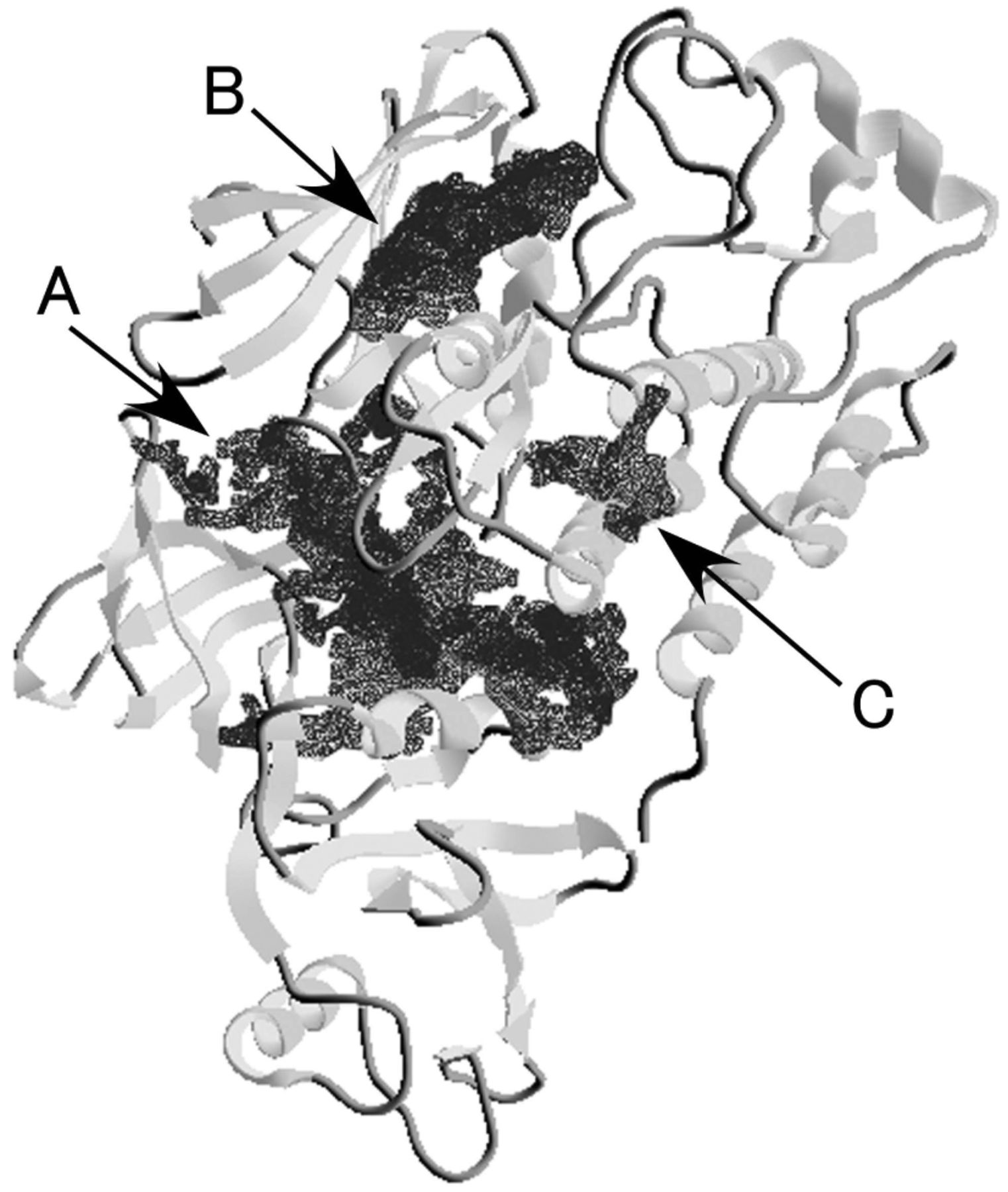
Figure 2.
  • Download figure
  • Open in new tab
  • Download powerpoint
Figure 2.

Binding pockets of the Src kinase molecule. Ligand-binding pockets (A-C) were determined by molecular simulation.

The binding position of TX-1926 was near to that of c-AMP (Figure 4C). TX-1926 showed good binding energy (−116.078 kcal/mol) similar to that for TX-1123, whereas its kinase inhibitory activity was weaker than those of TX-1123, TX-1925, and TX-1918. The binding position of TX-1927 was almost the same as that of TX-1123 (Figure 4D). TX-1927 interacted with the phenolic hydroxyl group of Tyr416 and amino group of Gly276 of Src kinase through its own phenolic hydroxyl group and cyano group, respectively (data not shown). The binding energy and Src kinase inhibition of TX-1927 (−98.813 kcal/mol, IC50 >340 μM) were significantly weaker than those of TX-1123. AG17 bound at different sites in Src kinase to the TX-1123 derivatives, and the phenolic hydroxyl group of Tyr90 interacted with cyano group of AG17. The two carboxyl groups of Tyr149 and Gln144 of Src kinase interacted with the phenolic hydroxyl group of AG17 (Figure 4F). The binding energy of AG17 (−98.821 kcal/mol) was equivalent to that of TX-1927.

Figure 3.
  • Download figure
  • Open in new tab
  • Download powerpoint
Figure 3.

Binding profile of ligands to Src kinase. A: c-AMP fitted in pocket B (see Figure 2) of Src kinase. B: TX-1123 fitted in pocket B as well as c-AMP did. C: The phenolic hydroxy group of TX-1123 interacted with Tyr416 of Src kinase.

Figure 4.
  • Download figure
  • Open in new tab
  • Download powerpoint
Figure 4.

Interaction profiles of TX-1123 derivatives with Src kinase. TX-1925 (A), TX-1918 (B), TX-1926 (C), and TX-1927 (D) fitted in Src kinase pocket B. Tyrphostin AG17 fitted in a different Src kinase site (pocket A) from TX-1123 derivatives. The cyano group of tyrphostin AG17 interacted with the hydroxyl group of Src kinase Tyr90, and the phenolic hydroxyl group of tyrphostin AG17 interacted with two carboxyl groups of Src kinase Tyr149 and Gln144 (F).

Discussion

2-Arylidine-4-cyclopentene-1,3-diones, which are unique soft acid-type electrophilic cyclopentene-1,3-dione moieties, were reported to be antitumor compounds (17). We previously developed non-nitro radiosensitizing hypoxic cytotoxin 2-hydroxyarylidene-4-cyclopentene-1,3-diones such as KIH-200, KIH-201, and KIH-202 (18). These synthesized KIH family members were found to be potent inhibitors of phosphate transport in mitochondria (19). We also developed the hydroxy-benzylidene-cyclopentenedione compound as a phenolic enhancer of chemiluminescence and found that KIH-201 was a potent enhancer of the luminol-hydrogen-horseradish peroxidase peroxide reaction (20). These cyclopentenedione moieties instead of the malononitrile moieties found in tyrphostin AG17 were expected to result in reduced mitochondrial toxicity. Tyrphostin AG17 exhibited potent mitochondrial cytotoxicity, such as mitochondrial uncoupling activity (Cmax=0.02 μM, Vmax=270 nanoatom O/mg/min) and inhibition of ATP synthesis (IC50=0.0035 μM) (14). TX-1123 was a designed tyrphostin AG17 analog, and exhibited lower mitochondrial toxicity [uncoupling activity (Cmax=2 μM, Vmax=260 nanoatom O/mg/min) and inhibition of ATP synthesis (IC50=5 μM)].

Different binding characteristics of TX-1123 family members to the Src kinase molecule compared with those of c-AMP binding were observed in a binding simulation. In general, native protein kinase was found to exist with a solvent molecule (e.g. water), and some solvent molecules were included in the kinase pocket (21). The X-ray data for c-AMP interaction with Src kinase is from one moment in time, and reflects neither molecular fluctuation nor interaction with solvent (22-25). A molecular docking simulation is considered appropriate because the verified interactive analysis between a ligand (e.g. TX-1123 family member) and protein (e.g. Src kinase) is performed with various solvents.

TX-1123 bound to a site near the c-AMP-binding pocket in the Src kinase molecule, and inhibited kinase activity. The phenolic hydroxy group of TX-1123 interacted with Src kinase Tyr460, and the methylation of this hydroxy group, such as in TX-1925, inhibited kinase activity by suppressing the interaction with Src kinase. In the TX-1918 molecule without the bulky t-butyl groups of TX-1123, the mobility of the phenolic hydroxy group increased, indicating reaction characteristics different from those of TX-1123 by an interaction with Phe405 in Src kinase.

The motility (flexibility) of TX-1926 was altered by the addition of a six-membered ring to the 1,3-dicyclopentenedion site, and the anti-kinase activity decreased. In tyrphostin AG17, the 1,3-cyclopentenedione site was substituted for the cyano group, and the molecular frame was altered. The structural characteristics of tyrphostin AG17 were altered more than those of TX-1123, and not only the phenolic hydroxy group, but also the cyano group interacted with the Src kinase molecule. TX-1927 had a molecular backbone to similar that of tyrphostin AG17, and reactivity with Src kinase was not affected by the methylation of the phenolic hydroxy group. This result did not contradict Src kinase inhibitory activity not being significantly influenced by the methylation of the phenolic group in the TX-1925 molecule.

It appears to be possible to develop drugs with anticancer activity based on the control of protein kinase function, even with small molecules such as members of the TX-1123 family, by using a simulation of molecular interaction with a target protein kinase.

Acknowledgements

This work was supported, in part, by Grant-in-Aid for Scientific Research (15K08113) from the Ministry of Education, Culture, Sports, Science and Technology of the Japanese Government.

  • Received April 5, 2016.
  • Revision received May 18, 2016.
  • Accepted May 24, 2016.
  • Copyright© 2016 International Institute of Anticancer Research (Dr. John G. Delinassios), All rights reserved

References

  1. ↵
    1. Ullrich A,
    2. Schlessinger J
    : Signal transduction by receptors with tyrosine kinase activity. Cell 61: 203-212, 1990.
    OpenUrlCrossRefPubMed
    1. Richardson JM,
    2. Morla AO,
    3. Wang J Y
    : Reduction in protein tyrosine phosphorylation during differentiation of human leukemia cell line K-562. Cancer Res 47: 4066-4070, 1987.
    OpenUrlAbstract/FREE Full Text
    1. Levitzki A
    : Tyrphostins: tyrosine kinase blockers as novel antiproliferative agents and dissectors of signal transduction. FABES J 6: 3275-3282, 1992.
    OpenUrl
    1. Blume-Jensen P,
    2. Hunter T
    : Oncogenic kinase signalling. Nature 411: 355-365, 2001.
    OpenUrlCrossRefPubMed
  2. ↵
    1. Hubbard S R,
    2. Till J H
    : Protein tyrosine kinase structure and function. Annu Rev Biochem 69: 373-398, 2000.
    OpenUrlCrossRefPubMed
  3. ↵
    1. Levitzki A,
    2. Gazit A
    : Tyrosine kinase inhibition: an approach to drug development. Science 267: 1782-1788, 1995.
    OpenUrlAbstract/FREE Full Text
    1. Umezawa H,
    2. Imoto M,
    3. Sawa T,
    4. Isshiki K,
    5. Matsuda N,
    6. Uchida T,
    7. Iinuma H,
    8. Hamada M,
    9. Takeuchi T
    : Studies on a new epidermal growth factor-receptor kinase inhibitor, erbstatin, produced by MH435-hF3. J Antibiot 39: 170-173, 1986.
    OpenUrlPubMed
  4. ↵
    1. Yaish P,
    2. Gazit A,
    3. Gilon C,
    4. Levitzki A
    . Blocking of EGF-dependent cell proliferation by EGF receptor kinase inhibitors. Science 242: 933-935, 1988.
    OpenUrlAbstract/FREE Full Text
  5. ↵
    1. Gazit A,
    2. Yaish P,
    3. Gilon C,
    4. Levitzki A
    : Tyrphostins I: synthesis and biological activity of protein tyrosine kinase inhibitors. J Med Chem 32: 2344-2352, 1989.
    OpenUrlCrossRefPubMed
  6. ↵
    1. Levitzki A
    : Tyrphostins–potential antiproliferative agents and novel molecular tools. Biochem Pharmacol 40: 913-918, 1990.
    OpenUrlCrossRefPubMed
  7. ↵
    1. Ohkura K,
    2. Hori H
    : Modification of cell response to insulin by membrane-acting agents in rat white adipocytes: analysis of structural features by computational simulation. Bioorg Med Chem 9: 3023-3033, 2001.
    OpenUrlPubMed
  8. ↵
    1. Palumbo G A,
    2. Yarom N,
    3. Gazit A,
    4. Sandalon Z,
    5. Baniyash M,
    6. Kleinberger-Doron N,
    7. Levitzki A,
    8. Ben-Yehuda D
    : The tyrphostin AG17 induces apoptosis and inhibition of CDK2 activity in a lymphoma cell line that overexpresses BCL-2. Cancer Res 57: 2434-2439, 1997.
    OpenUrlAbstract/FREE Full Text
  9. ↵
    1. Terada H,
    2. Fukui Y,
    3. Shinohara Y,
    4. Ju-ichi M
    : Unique action of a modified weakly acidic uncoupler without an acidic group, methylated SF 6847, as an inhibitor of oxidative phosphorylation with no uncoupling activity: possible identity of uncoupler binding protein. Biochim Biophys Acta 933: 193-199, 1988.
    OpenUrlPubMed
  10. ↵
    1. Hori H,
    2. Nagasawa H,
    3. Ishibashi M,
    4. Uto Y,
    5. Hirata A,
    6. Saijo K,
    7. Ohkura K,
    8. Kirk K L,
    9. Uehara Y
    : TX-1123: An antitumor 2-hydroxyarylidene-4-cyclopentene-1,3-dione as a protein tyrosine kinase inhibitor having low mitochondrial toxicity. Bioorg Med Chem 10: 3257-3265, 2002.
    OpenUrlPubMed
  11. ↵
    1. Kawaguchi Y,
    2. Tabata A,
    3. Nagamune H,
    4. Ohkura K
    : Profiles of ILY, VLY and Sm-hPAF interaction with human CD59. Anticancer Res 33: 2901-2904, 2013.
    OpenUrlAbstract/FREE Full Text
  12. ↵
    1. Ohkura K,
    2. Kawaguchi Y,
    3. Tabata A,
    4. Yamamoto A,
    5. Shinohara Y,
    6. Nagamune H,
    7. Hori H
    : Molecular profiles of cholesterol-dependent cytolysin family-derived 11mer regions. Anticancer Res 32: 2343-2346, 2012.
    OpenUrlAbstract/FREE Full Text
  13. ↵
    1. Inayama S,
    2. Mamoto K,
    3. Shibata T,
    4. Hirose T
    : Structure and antitumor activity relationship of 2-arylidene-4-cyclopentene-1,3-diones and 2-arylideneindan-1,3-diones. J Med Chem 19: 433-436, 1976.
    OpenUrlPubMed
  14. ↵
    1. Hori H,
    2. Maezawa H,
    3. Iitaka Y,
    4. Ohsaka T,
    5. Shibata T,
    6. Mori T,
    7. Inayama S
    : 2-Arylidene-4-cyclopentene-1,3-diones designed as non-nitro radiosensitizers and hypoxic cytotoxins. Jpn J Cancer Res 78: 1128-1133, 1987.
    OpenUrlPubMed
  15. ↵
    1. Koike H,
    2. Hori H,
    3. Inayama S,
    4. Terada H
    : Effect of arylidene-cyclopentenedione radiosensitizers on ATP synthesis in mitochondria: Action as potent inhibitors of phosphate transport. Biochem Biophys Res Commun 155: 1066-1074, 1988.
    OpenUrlPubMed
  16. ↵
    1. Hori H,
    2. Fujii T,
    3. Kubo A,
    4. Pan N,
    5. Sako S,
    6. Tada C,
    7. Matsubara T
    : KIH-201: a new enhancer of chemiluminescence in the luminol-hydrogen peroxide-peroxidase system characterized by a high-performance luminometer. Anal Lett 27: 1109-1122, 1994.
    OpenUrl
  17. ↵
    1. Otto R,
    2. Brox J,
    3. Trippel S,
    4. Stei M,
    5. Best T,
    6. Wester R
    : Single solvent molecules can affect the dynamics of substitution reactions. Nat Chem 4: 534-538, 2012.
    OpenUrlCrossRefPubMed
  18. ↵
    1. Helliwell JR
    : Macromolecular Crystallography with Synchrotron Radiation. Cambridge University Press, Cambridge, 1992.
    1. Gruner S M
    : X-Ray-detectors for macromolecular crystallography. Curr Opin Struct Biol 4: 765-769, 1994.
    OpenUrlCrossRef
    1. Rossmann M G,
    2. McKenna R,
    3. Tong L,
    4. Xia D,
    5. Dai J-B,
    6. Wu H,
    7. Choi H-K,
    8. Lynch R E
    : Molecular replacement real-space averaging. J Appl Cryst 25: 166-180, 1992.
    OpenUrlCrossRef
  19. ↵
    1. Brunger A T,
    2. Nilges M
    : Computational challenges for three dimensional structure determination by X-ray crystallography and solution NMR spectroscopy. Quart Rev Biophys 26: 49-125, 1993.
    OpenUrlPubMed
PreviousNext
Back to top

In this issue

Anticancer Research
Vol. 36, Issue 7
July 2016
  • Table of Contents
  • Table of Contents (PDF)
  • Index by author
  • Back Matter (PDF)
  • Ed Board (PDF)
  • Front Matter (PDF)
Print
Download PDF
Article Alerts
Sign In to Email Alerts with your Email Address
Email Article

Thank you for your interest in spreading the word on Anticancer Research.

NOTE: We only request your email address so that the person you are recommending the page to knows that you wanted them to see it, and that it is not junk mail. We do not capture any email address.

Enter multiple addresses on separate lines or separate them with commas.
An Antitumor 2-Hydroxyarylidene-4-cyclopentene-1,3-Dione as a Protein Tyrosine Kinase Inhibitor: Interaction Between TX-1123 Derivatives and Src Kinase
(Your Name) has sent you a message from Anticancer Research
(Your Name) thought you would like to see the Anticancer Research web site.
CAPTCHA
This question is for testing whether or not you are a human visitor and to prevent automated spam submissions.
18 + 1 =
Solve this simple math problem and enter the result. E.g. for 1+3, enter 4.
Citation Tools
An Antitumor 2-Hydroxyarylidene-4-cyclopentene-1,3-Dione as a Protein Tyrosine Kinase Inhibitor: Interaction Between TX-1123 Derivatives and Src Kinase
KAZUTO OHKURA, YUKI KAWAGUCHI, YOHEI TATEMATSU, YOSHIHIRO UTO, HITOSHI HORI
Anticancer Research Jul 2016, 36 (7) 3645-3649;

Citation Manager Formats

  • BibTeX
  • Bookends
  • EasyBib
  • EndNote (tagged)
  • EndNote 8 (xml)
  • Medlars
  • Mendeley
  • Papers
  • RefWorks Tagged
  • Ref Manager
  • RIS
  • Zotero
Reprints and Permissions
Share
An Antitumor 2-Hydroxyarylidene-4-cyclopentene-1,3-Dione as a Protein Tyrosine Kinase Inhibitor: Interaction Between TX-1123 Derivatives and Src Kinase
KAZUTO OHKURA, YUKI KAWAGUCHI, YOHEI TATEMATSU, YOSHIHIRO UTO, HITOSHI HORI
Anticancer Research Jul 2016, 36 (7) 3645-3649;
Twitter logo Facebook logo Mendeley logo
  • Tweet Widget
  • Facebook Like
  • Google Plus One

Jump to section

  • Article
    • Abstract
    • Materials and Methods
    • Results
    • Discussion
    • Acknowledgements
    • References
  • Figures & Data
  • Info & Metrics
  • PDF

Related Articles

Cited By...

  • Molecular Aspects of C-glycosides: Interactive Analysis of C-linked Compounds With the SGLT2 Molecular Model
  • Effect of Isomerization of TX-2036 Derivatives on the Interaction With Tyrosine Kinase Domain of EGF Receptor
  • Interactive Analysis of TX-1123 with Cyclo-oxygenase: Design of COX2 Selective TX Analogs
  • Google Scholar

More in this TOC Section

  • Current State of and Problems Related to Cancer of the Intestinal Tract Associated with Crohn's Disease in Japan
  • Adoptive Chemoimmunotherapy Using Activated αβ T Cells for Stage IV Colorectal Cancer
  • Screening for Identification of Personalized Food to Promote Adiponectin Secretion in Patients with Cancer
Show more PROCEEDINGS OF THE 19TH ANNUAL MEETING OF THE SOCIETY OF BIOTHERAPEUTIC APPROACHES, 5 December 2015 (Tokyo, Japan)

Keywords

  • protein kinase
  • Kinase inhibitor
  • TX-1123 derivatives
Anticancer Research

© 2026 Anticancer Research

Powered by HighWire