


Abstract
Background: We newly synthesized twenty 2-aminotropones with different lengths of methylene units, with or without introduction of isopropyl group at C-4 position of the cycloheptatriene ring, which were then subjected to quantitative structure–activity relationship (QSAR) analysis. Materials and Methods: Viable cell number was evaluated by the 3-(4,5-dimethylthiazol-2-yl)-2,5-diphenyltetrazolium bromide (MTT) method. The tumor specificity was determined by the ratio of the mean CC50 (50% cytotoxic concentration) for the normal cells (human gingival fibroblast, HGF) to that of the human oral squamous cell carcinoma (OSCC) cell line (Ca9-22) derived from gingival tissue. Anti-UV activity (SI) was determined by the ratio of CC50 to EC50 (the concentration that increased the viability of UV-irradiated cells to 50%) using HSC-2 OSCC cells. Physico-chemical, structural, and quantum-chemical parameters were calculated based on conformations optimized by the LowModeMD method followed by the Discrete Fourier Transform (DFT) method. Fine-cell structure was observed by transmission electron microscopy. Results: 2-Aminotropones induced cytotoxicity, accompanied by the production of many rough endoplasmic reticula with enlarged lacuna and vacuolated mitochondria. Their cytotoxicity was a positive function of the number of methylene units and hydrophobicity. Anti-UV activity showed a good correlation with lowest unoccupied molecular orbital (LUMO) energy, but not with the length of methylene units. All twenty 2-aminotropones induced a very low level of hormetic growth stimulation at lower concentrations. Conclusion: Different types of chemical descriptors may be applicable to estimating the cytotoxicity and anti-UV activity of 2-aminotropones.
Heterocylic compounds are known to display diverse biological activities (1). Hinokitiol and its related derivatives with a tropolone skeleton (2-4) have been reported to exhibit various biological activities, such as anti-microbial (5), anti-fungal (6) and phytogrowth-inhibitory activity (7, 8), cytotoxic effects on mammalian tumor cells (9, 10), and inhibitory effects on catechol-O-methyltransferase (11) and metalloproteases (5). Hinokitiol acetate did not exhibit any cytotoxic activity (10), anti-microbial activity nor metalloprotease inhibition (5), suggesting that these biological effects of hinokitiol-related compounds may result in the formation of metal chelates by the carbonyl group at C-1 with the hydroxyl group at C-2 in the tropone skeleton.
We have previously reported on several new biological activities of 2-aminotropone derivatives. 2-Aminotropones had a relatively higher tumor specificity than benzo[b]cyclohept[e][1,4]oxazine, and 2-aminotropones induced little or no apoptotic cell death in oral squamous cell carcinoma, in contrast to HL-60 cells (12). Benzo[b]cyclohept[e][1,4]oxazin-6(11H)-one and 7-bromo-2-(4-hydroxyanilino)tropone potently inhibited the production of nitric oxide by lipopolysaccharide-activated mouse macrophage-like RAW264.7 cells, via inhibition of inducible NO synthase and cyclooxygenase-2 protein expression (13). 2-Aminotropone derivatives induced growth stimulation known as hormesis, at low concentrations, especially in normal skin and lung fibroblasts, only at restricted times and concentrations (14), as has been previously reported (15).
In order to further pursue the structure-activity relationship of 2-aminotropones, we newly synthesized twenty 2-aminotropone derivatives that lack [1a-1j] or have [2a-2j] isopropyl group at C-5 position, with side chains of either (CH2)nCH3 [1a-1f, 2a-2f] or (CH2)nOH [1g-1j, 2g-2j] at the 2-amino group. In the present study we investigated their cytotoxicity and anti-UV activity, using human normal oral cells [gingival fibroblast (HGF), periodontal ligament fibroblast (HPLF)] and human oral squamous cell carcinoma (OSCC) cell lines (Ca9-22, HSC-2, HSC-3).
Materials and Methods
Materials. The following chemicals and reagents were obtained from the indicated companies: Dulbecco's modified Eagle's medium (DMEM), from GIBCO BRL (Grand Island, NY, USA); fetal bovine serum (FBS) and 3-(4,5-dimethylthiazol-2-yl)-2,5-diphenyltetrazolium bromide (MTT) from Sigma-Aldrich Inc. (St. Louis, MO, USA); dimethyl sulfoxide (DMSO) from Wako Pure Chem. Ind., Osaka, Japan; sodium ascorbate from Tokyo Chemical Industry Co., Ltd., Tokyo, Japan. Culture plastic dishes and plates (96-well) were purchased from Becton Dickinson (Franklin Lakes, NJ, USA).
Synthesis of test compounds. 2-N-Methylaminotropone [1a], 2-N-ethylaminotropone [1b], 2-N-n-propylaminotropone [1c], 2-N-n-butylaminotropone [1d], 2-N-n-pentylaminotropone [1e], 2-N-n-hexylaminotropone [1f], 2-N-(2-hydroxyethyl)aminotropone [1g], 2-N-(3-hydroxypropyl)aminotropone [1h], 2-N-(4-hydroxybutyl) aminotropone [1i], 2-N-(5-hydroxypentyl)aminotropone [1j], 2-N-methylamino-5-isopropyltropone [2a], 2-N-ethylamino-5-isopropyltropone [2b], 2-N-n-propylamino-5-isopropyltropone [2c], 2-N-n-butylamino-5-isopropyltropone [2d], 2-N-n-pentylamino-5-isopropyltropone [2e], 2-N-n-hexylamino-5-isopropyltropone [2f], 2-N-(2-hydroxyethyl)amino-5-isopropyltropone [2g], 2-N-(3-hydroxypropyl)amino-5-isopropyltropone [2h], 2-N-(4-hydroxybutyl)amino-5-isopropyltropone [2i], 2-N-(5-hydroxypentyl) amino-5-isopropyltropone [2j] were synthesized (Figure 1), according to previous methods (16-19). All compounds were dissolved in phosphate-buffered saline without calcium and magnesium [PBS(−)] at 80 mM and stored at −20°C before use.
Cell culture. HGF and HPLF cells, established from the first premolar tooth extracted from the lower jaw of a 12-year-old girl (20) and OSCC cell lines (Ca9-22, HSC-2, HSC-3), purchased from Riken Cell Bank, Tsukuba, Japan were cultured at 37°C in DMEM supplemented with 10% heat-inactivated FBS, 100 units/ml, penicillin G and 100 μg/ml streptomycin sulfate under a humidified 5% CO2 atmosphere. Cells were then harvested by treatment with 0.25% trypsin-0.025% EDTA-2Na in PBS(−) and either subcultured or used for experiments.
Assay for cytotoxic activity. Cells were inoculated at 3×10³ cells/0.1 ml in the inner 60 wells of a 96-microwell plate (Becton Dickinson Labware, NJ, USA). The surrounding 36 exterior wells were filled with 0.1 ml of PBS(−) to minimize the evaporation of water from the culture medium. After 48 h, the medium was removed by suction with aspirator, and replaced with 0.1 ml of fresh medium containing different concentrations of single test compounds (0, 3.9, 7.8, 15.6, 31.3, 62.5, 125, 250, 500 μM). Cells were incubated for 48 h, and the relative viable cell number was then determined by MTT method. In brief, treated cells were incubated for another 3 hours in fresh culture medium containing 0.2 mg/ml MTT. Cells were then lysed with 0.1 ml of DMSO, and the absorbance at 540 nm of the cell lysate was determined using a microplate reader (Biochromatic Labsystem, Helsinki, Finland). The 50% cytotoxic concentration (CC50) was determined from the dose–response curve and the mean value of CC50 for each cell type was calculated from 3 independent experiments. The tumor-specificity index (TS) was determined by the following equation: TS=CC50[HGF]/CC50[Ca9-22].

Chemical structure of 2-aminotropones [1a-1j] and their isopropylated derivatives [2a-2j].
Assay for hormesis. Hormetic response was evaluated by the maximum response in each dose-response curve, as described previously (14, 15).
Assay for UV protection. The medium of near-confluent HSC-2 cells attached to 96-microwell plates was replaced with PBS(-). Different concentrations of water-soluble test samples were then added to the cell, all the plates were immediately placed at 21 cm from a UV lamp (wavelength 253.7 nm) and exposed to UV irradiation (6 J/m2/min) for 1 min (21). The media were replaced with fresh culture medium and cells were then cultured at 37°C in an incubator with 5% CO2 until 48 h after the start of irradiation. From the dose-response curve, 50% cytotoxic concentration (CC50) and the concentration that increased the viability of UV-irradiated cells to 50% (EC50) were determined. The selectivity index (SI) was determined by the following equation: SI=CC50/EC50.
Fine-cell structure. Near-confluent Ca9-22 and HGF cells were treated for 3 h without (control) or with 25 or 50 μM [2f], respectively. The cells were washed three times with cold PBS(−) and fixed for 1 h with 2% gultaraldehyde in 0.1 M cacodylate buffer (pH 7.4) at 4°C, scraped with a rubber policemen, post-fixed for 90 minutes with 1% osmium tetraoxide-0.1 M cacodylate buffer (pH 7.4), dehydrated and then embedded in Araldite M (CIBA-GEIGY Swiss; NISSHIN EN Co., Ltd., Tokyo Japan). Thin sections were stained with uranyl acetate and lead citrate, and were then observed under a JEM-1210 transmission electron microscope (TEM) (Japan Electron Optics Laboratory Co., Ltd., Akishima, Tokyo, Japan) at an accelerating voltage of 100 kV (22).
Cytotoxic activity, anti-UV activity and hormesis-inducing activity of twenty 2-aminotropone derivatives. Each value represents the mean of three independent experiments, each of which was performed in triplicate.
Cytotoxicity of 2-aminotropone derivatives towards human oral normal and tumor cells. Each value represents the mean of triplicate determinations.
Calculation of chemical descriptors. Each chemical structure was optimized by the LowModeMD method (23), a suitable search method for minimum energy conformers of flexible molecules, with Merck Molecular Force Field (MMFF94) in Molecular Operating Environment (MOE) 2011.10 (Chemical Computing Group Inc., Quebec, Canada). Each structure was refined with density functional theory (DFT-B3LYP/6-31G**) by using Spartan10 for Windows (Wavefunction, Inc., Irvine, CA, USA) (24). During each step of the calculation, quantum chemical, molecular shape, and molecular property parameters were obtained. The parameters used were: energy, HOMO (highest occupied molecular orbital) energy, LUMO (lowest unoccupied molecular orbital) energy, dipole moment, surface area of the molecule, volume of the molecule, polar surface area (PSA), negativity [χ=−(ELUMO + EHOMO)/2], absolute hardness [η=(EUMO −EHOMO)/2], electrophilicity index (ω=χ2/2η), Ovality, hydrophobicity (log P), water accessible surface area, and molecular weight.
Statistical treatment. The relation among cytotoxicity, tumor specificity index, anti-UV activity and chemical descriptors was investigated using simple regression analyses by JMP Pro version 10.0.2 (SAS Institute Inc., Cary, NC, USA). The significance level was set at p<0.05.
Results
Cytotoxicity. Introduction of isopropyl group to C-5 position of compounds 1a-1j slightly enhanced the cytotoxicity of 2a-2j against both Ca9-22 and HGF cells (first column in Table I). Cytotoxicity of 1a-1f and their isopropylated derivatives 2a-2f increased with an increase in the number of methylene units in the side-chain at the amino group (Figure 2A and C). By introducing an OH group at the terminal of methylene side-chains, their cytotoxicity was almost completely eliminated (Figure 2B and D). Among these 20 compounds, 1f and 2f showed the highest cytotoxicity (Table I). Ca9-22 cells cultured for 3 h with 25 μM 2f possessed many rough endoplasmic reticula with enlarged lacuna and vacuolated mitochondria (Figure 3B). Similarly, HGF cells treated for 3 h with 50 μM 2f had a round-shaped outline and contained rough endoplasmic reticula with enlarged lacuna and high-electron dense vacuoles (Figure 3D). Both Ca9-22 and HGF cells cultured without 2f had normal morphology (Figure 3A and C). These results suggest that 2f was strongly cytotoxic against both epithelial and fibroblastic cells in oral cavity.
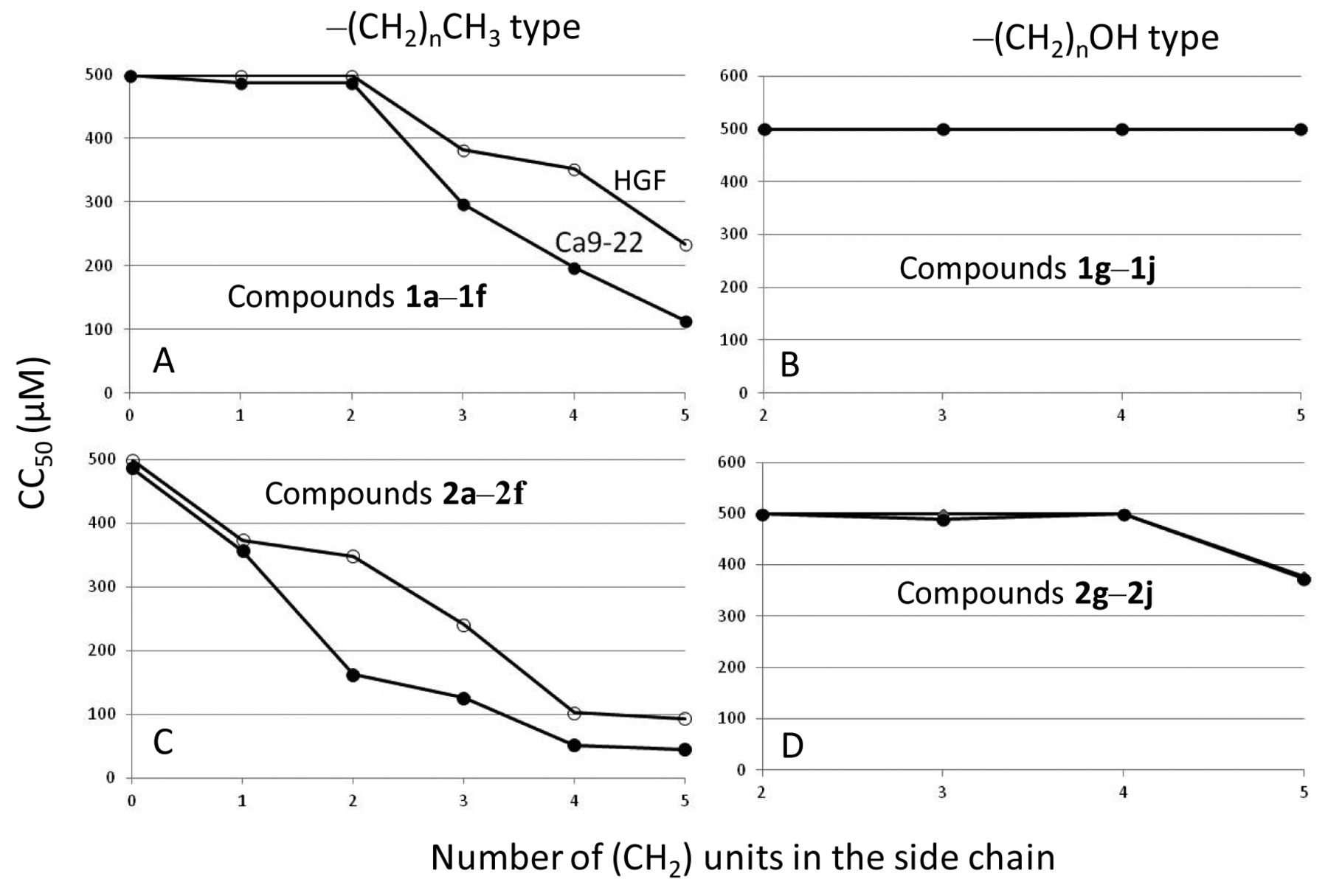
Cytotoxicity of 2-aminotropones as a function of the number of methylene units of compounds [1a-1f] (A), [1g-1j] (B), [2a-2f] (C) and [2g-2j] (D).
Ca9-22 cells were slightly more sensitive to 2-aminotropones compared to HGF cells. Compounds 1f, 2c and 2f had the highest TS of 2.05, 2.13 and 2.09, respectively (Table I). Repeated experiments with two normal (HGF, HPLF) and three cancer (HSC-2, HSC-3, Ca9-22) cell lines confirmed that 1f and 2f had TS values of 2.7 and 2.2, respectively (Table II).
Anti-UV activity. Exposure of HSC-2 cells to short pulse of UV irradiation (6 J/m2/min, 1 min) in PBS(−) almost completely eradicated cellular viability, determined after 24 h incubation in regular culture medium (closed symbol at 0 mM, Figure 4). Addition of 2-aminotropone derivatives during the UV irradiation protected cells from UV irradiation to various extents, with SIs ranging from 0.11 to 5.56 (second column in Table I).
Hormesis induction. 2-Aminotropone compounds induced very low level of hormetic effects at their lower concentrations, with the hormetic response ranges of 10-34% (HGF cells), 6-42% (Ca9-22 cells) and 0-54% (HSC-2 cells), respectively (third column in Table I). There was no consistency in the distribution of the values of hormetic response of the 20 samples between the three cell lines.
Discussion
The present study demonstrated that cytotoxicity of twenty newly-synthesized 2-aminotropone derivatives was increased with an increase number in the of methylene units. We performed QSAR analysis, and among the 14 parameters tested, the log p value (octanol/water partition coefficient) showed the highest correlation to their cytotoxicity. When log p exceeded 0.97, cytotoxicity against Ca9-22 was detectable, whereas when log P exceeded 1.46, cytotoxicity against HGF cells (which are more resistant to 2-aminotropones) was detectable (fourth column in Table I, Figure 5A). With a further increase in log p, cytotoxicity against both cell lines further increased (CC50 value diminished) (Figure 5A). This suggests that cytotoxicity of 2-aminotropone derivatives depends on their cell membrane permeability.

Changes in fine cell structures induced by compound 2f. Near-confluent Ca9-22 (A, B) and human gingival fibroblast (HGF) (C, D) were treated for 3 hours without (A, C) or with 25 (B) or 50 (D) μM compound 2f, respectively, fixed and then observed under transmission electron microscopy (TEM).
The present study also demonstrated that tumor specificity was positively-related to cytotoxicity (Figure 5B), whereas anti-UV activity was negatively-related to cytotoxicity (Figure 5C), thus producing a negative correlation between cytotoxicity and anti-UV activity (Figure 5D).
Although the anti-UV activity was poorly-correlated with the length of methylene side-chains (r2=0.01), it showed good correlation with LUMO energy (r2=0.731), electrophilicity index (r2=0.717), electronegativity (r2=0.707), PSA (r2=0.699), log p (r2=0.640), HOMO energy (r2=0.615), and some correlation with dipole moment (r2=0.453) and ovality (r2=0.244) (Figure 6). Different types of chemical descriptors may be applicable to estimate the cytotoxicity and anti-UV activity of 2-aminotropones.
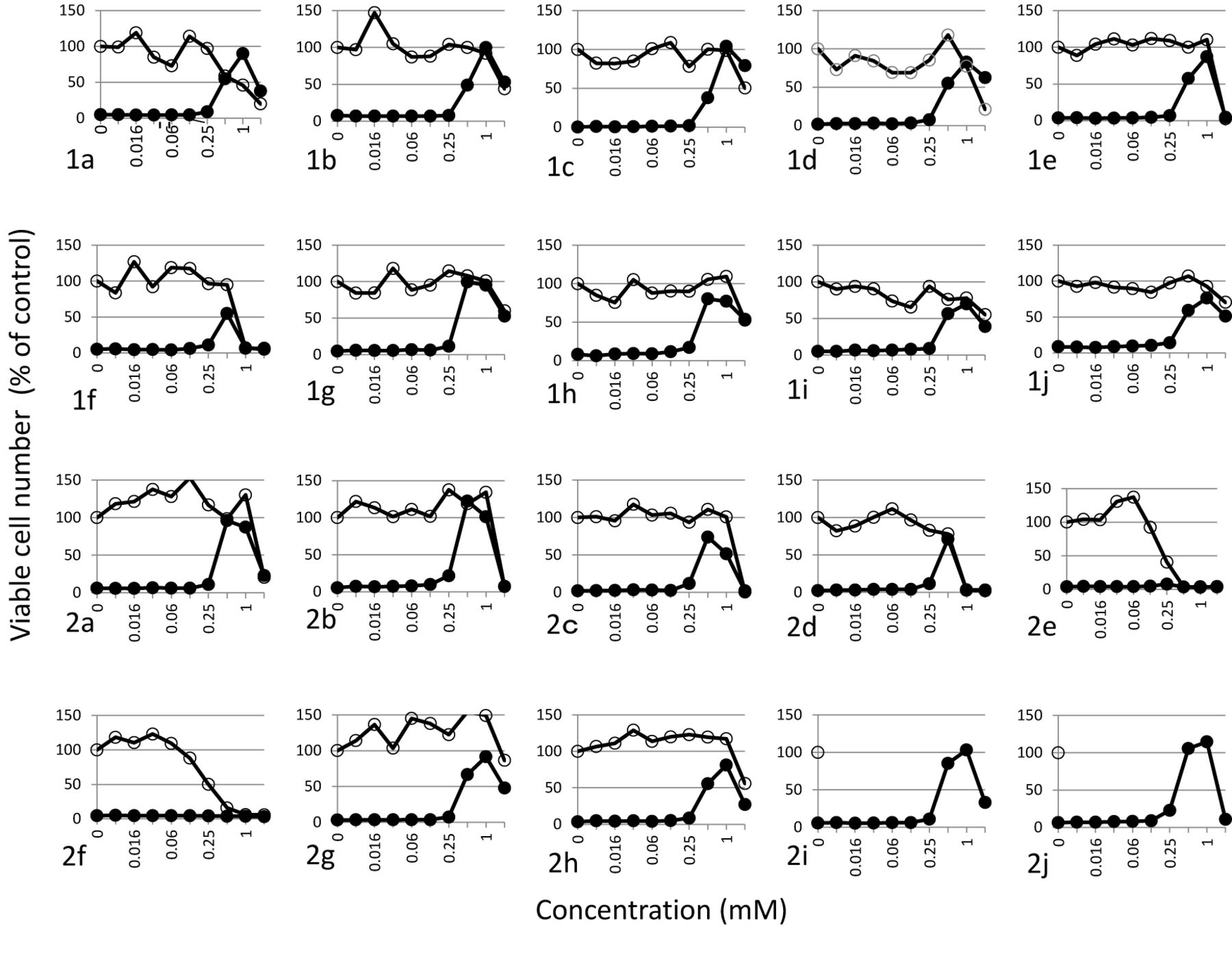
Anti-UV activity of 2-aminotropones. Near-confluent HSC-2 cells were UV-irradiated (1 min) (●) or not (○) in PBS(−), and cultured for 24 h in regular culture medium to determine viable cells by the MTT method. Each value represents the mean from triplicate determination.
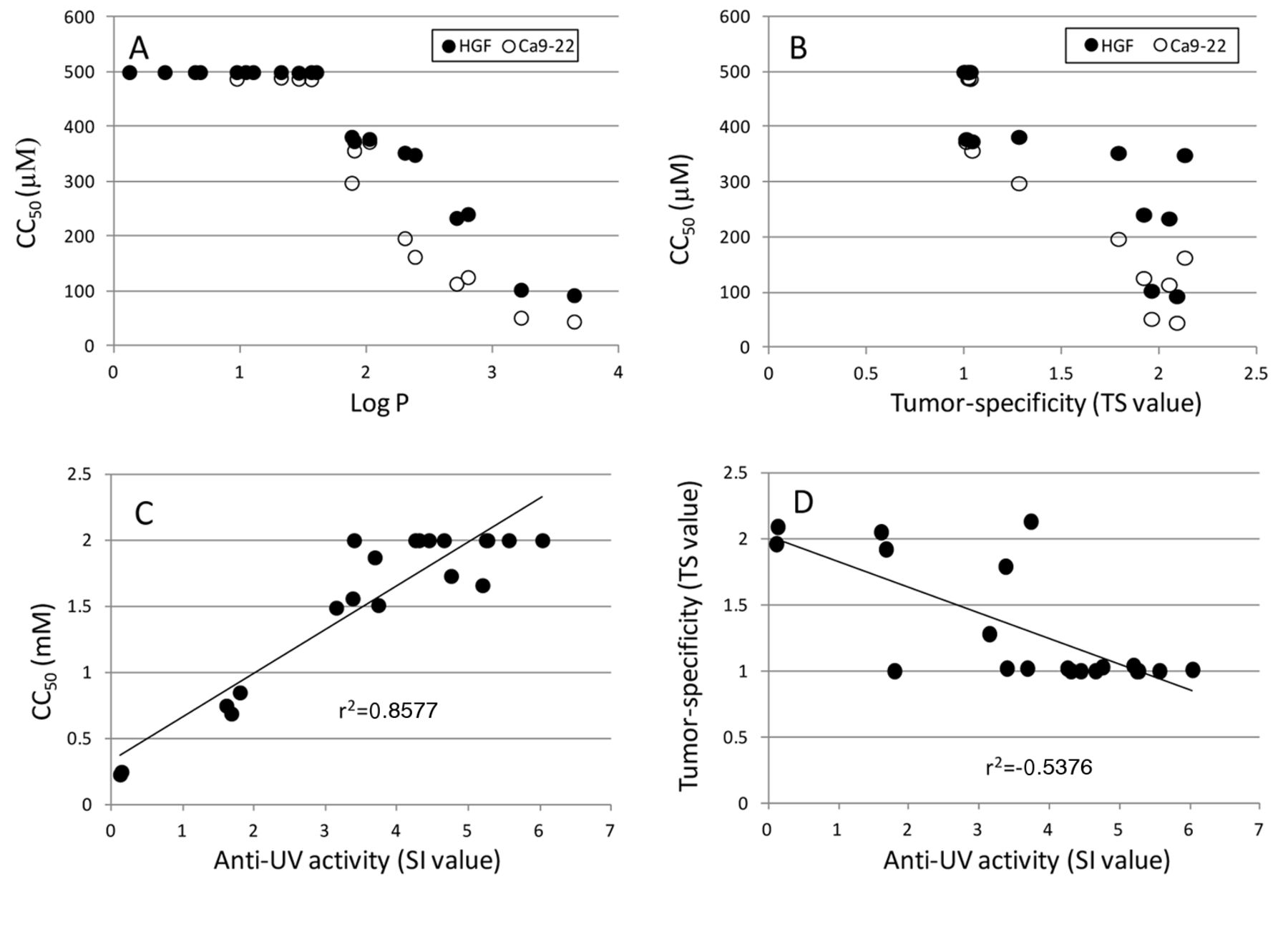
Relationship between cytotoxicity and log p (A), tumor specificity (B) and anti-UV activity (C), and that between tumor specificity and anti-UV activity (D) of 2-aminotropones.

Correlation coefficient of chemical descriptors and anti-UV activity, defined as selectivity index (SI) value.
The present study demonstrated that all twenty 2-aminotropones were poor inducers of hormesis in HGF, Ca9-22 and HSC-2 cells. Taken together with our previous data, normal and oral tumor cells are relatively resistant to hormetic induction regardless of the type of inducer: whether chemical (14, 21, 25), laser irradiation (26, 27) or Chinese medicine (28).
- Received December 4, 2013.
- Revision received January 8, 2014.
- Accepted January 10, 2014.
- Copyright© 2014 International Institute of Anticancer Research (Dr. John G. Delinassios), All rights reserved


