Main menu

  • Home
  • Current Issue
  • Archive
  • Info for
    • Authors
    • Editorial Policies
    • Subscribers
    • Advertisers
    • Editorial Board
    • Special Issues
  • Journal Metrics
  • Other Publications
    • In Vivo
    • Cancer Genomics & Proteomics
    • Cancer Diagnosis & Prognosis
  • More
    • IIAR
    • Conferences
    • 2008 Nobel Laureates
  • About Us
    • General Policy
    • Contact
  • Other Publications
    • Anticancer Research
    • In Vivo
    • Cancer Genomics & Proteomics

User menu

  • Register
  • Subscribe
  • My alerts
  • Log in
  • My Cart

Search

  • Advanced search
Anticancer Research
  • Other Publications
    • Anticancer Research
    • In Vivo
    • Cancer Genomics & Proteomics
  • Register
  • Subscribe
  • My alerts
  • Log in
  • My Cart
Anticancer Research

Advanced Search

  • Home
  • Current Issue
  • Archive
  • Info for
    • Authors
    • Editorial Policies
    • Subscribers
    • Advertisers
    • Editorial Board
    • Special Issues
  • Journal Metrics
  • Other Publications
    • In Vivo
    • Cancer Genomics & Proteomics
    • Cancer Diagnosis & Prognosis
  • More
    • IIAR
    • Conferences
    • 2008 Nobel Laureates
  • About Us
    • General Policy
    • Contact
  • Visit us on Facebook
  • Follow us on Linkedin
Research ArticleExperimental Studies

Evaluation of Cytotoxiciy and Tumor-specificity of Licorice Flavonoids Based on Chemical Structure

HIROKAZU OHNO, DAISUKE ARAHO, YOSHIHIRO UESAWA, HAJIME KAGAYA, MARIKO ISHIHARA, HIROSHI SAKAGAMI and MASAJI YAMAMOTO
Anticancer Research August 2013, 33 (8) 3061-3068;
HIROKAZU OHNO
1Maruzen Pharmaceuticals Co., Ltd., Shibuya, Tokyo, Japan
  • Find this author on Google Scholar
  • Find this author on PubMed
  • Search for this author on this site
  • For correspondence: h-ohno{at}maruzenpcy.co.jp
DAISUKE ARAHO
1Maruzen Pharmaceuticals Co., Ltd., Shibuya, Tokyo, Japan
  • Find this author on Google Scholar
  • Find this author on PubMed
  • Search for this author on this site
YOSHIHIRO UESAWA
2Department of Clinical Pharmaceutics, Meiji Pharmaceutical University, Kiyose, Tokyo, Japan
  • Find this author on Google Scholar
  • Find this author on PubMed
  • Search for this author on this site
HAJIME KAGAYA
2Department of Clinical Pharmaceutics, Meiji Pharmaceutical University, Kiyose, Tokyo, Japan
  • Find this author on Google Scholar
  • Find this author on PubMed
  • Search for this author on this site
MARIKO ISHIHARA
3Division of Basic Chemistry, Meikai University School of Dentistry, Sakado, Saitama, Japan
  • Find this author on Google Scholar
  • Find this author on PubMed
  • Search for this author on this site
HIROSHI SAKAGAMI
4Division of Pharmacology, Meikai University School of Dentistry, Sakado, Saitama, Japan
  • Find this author on Google Scholar
  • Find this author on PubMed
  • Search for this author on this site
MASAJI YAMAMOTO
1Maruzen Pharmaceuticals Co., Ltd., Shibuya, Tokyo, Japan
  • Find this author on Google Scholar
  • Find this author on PubMed
  • Search for this author on this site
  • Article
  • Figures & Data
  • Info & Metrics
  • PDF
Loading

Article Figures & Data

Figures

  • Tables
  • Figure 1.
    • Download figure
    • Open in new tab
    • Download powerpoint
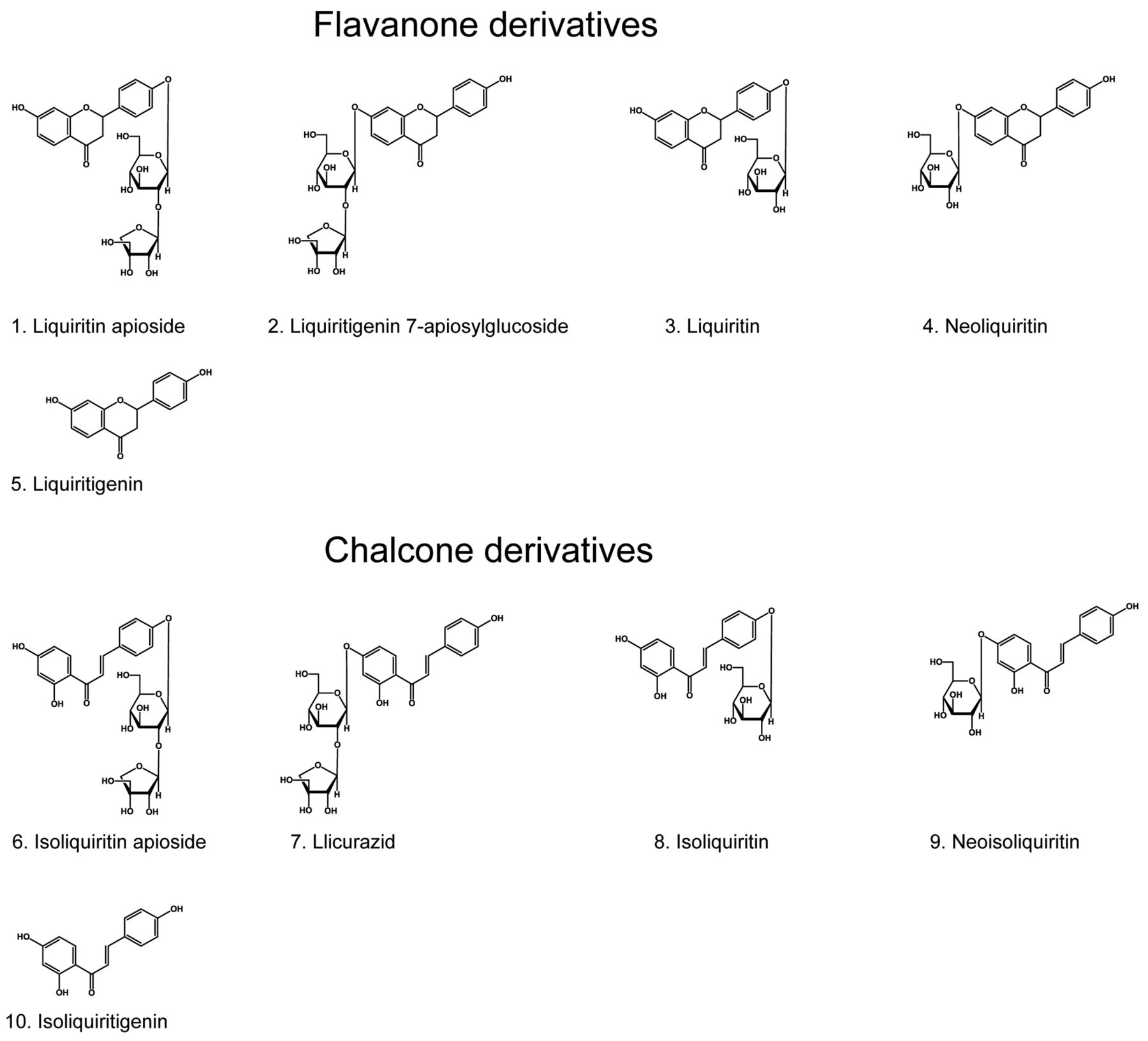
    Figure 1.

    Structures of licorice flavonoids.

  • Figure 2.
    • Download figure
    • Open in new tab
    • Download powerpoint
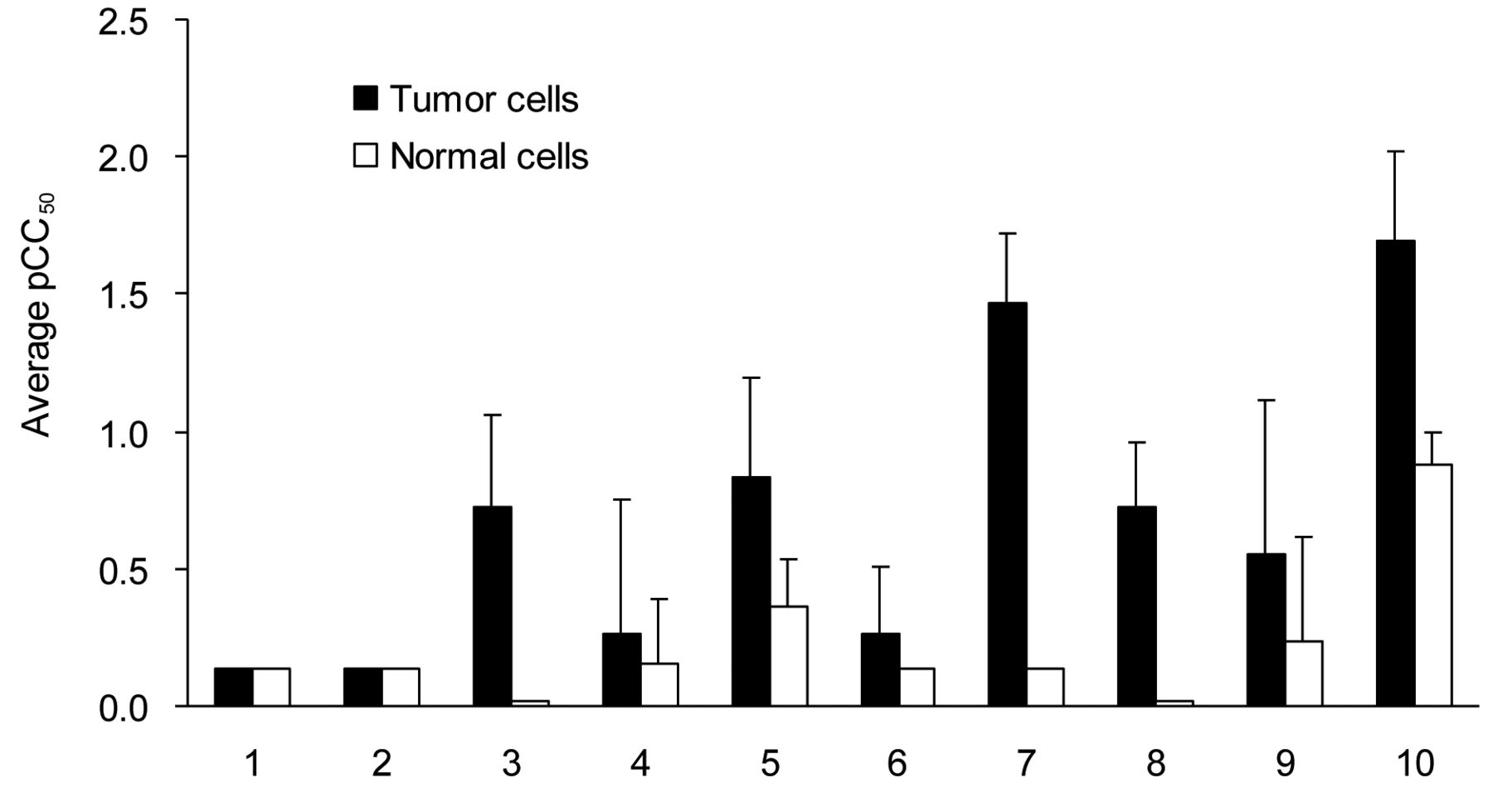
    Figure 2.

    Cytotoxicity of licorice flavonoids against human tumor and normal cells. The height and vertical bars represent mean + SD, respectively. Cytotoxicity was estimated as an average of −logCC50 (pCC50). 1. liquiritin apioside; 2, liquiritigenin 7-apiosylglucoside; 3, liquiritin; 4, neoliquiritin; 5, liquiritigenin; 6, isoliquiritin apioside; 7, licurazid; 8, isoliquiritin; 9, neoisoliquiritin; 10, isoliquiritigenin.

  • Figure 3.
    • Download figure
    • Open in new tab
    • Download powerpoint
    Figure 3.

    Comparison between flavanone and chalcone groups for the cytotoxicity and specificity. The estimated 50% cytotoxic concentration against tumor (T) and that against normal cells (N), and the tumor-specificity index, estimated as the ratio of (T-N)/(T+N) are shown. The height and vertical bars represent the mean and SD, respectively.

  • Figure 4.
    • Download figure
    • Open in new tab
    • Download powerpoint
    Figure 4.

    Effect of the number of sugar units on the cytotoxicity and tumor specificity of licorice flavonoids.

  • Figure 5.
    • Download figure
    • Open in new tab
    • Download powerpoint
    Figure 5.

    Scatter plot of the estimated 50% cytotoxic concentration (CC50) against tumor cells (T) and that against normal cells (N).

  • Figure 6.
    • Download figure
    • Open in new tab
    • Download powerpoint
    Figure 6.

    Tumor specificity of licorice flavonoids. The tumor-specificity index was estimated as the ratio of (T-N)/(T+N), whereas N and T were the estimated 50% cytotoxic concentrations of each compound against normal and tumor cells, respectively. 1. Liquiritin apioside; 2, liquiritigenin 7-apiosylglucoside; 3, liquiritin; 4, neoliquiritin; 5, liquiritigenin; 6, isoliquiritin apioside; 7, licurazid; 8, isoliquiritin; 9, neoisoliquiritin; 10, isoliquiritigenin.

  • Figure 7.
    • Download figure
    • Open in new tab
    • Download powerpoint
    Figure 7.

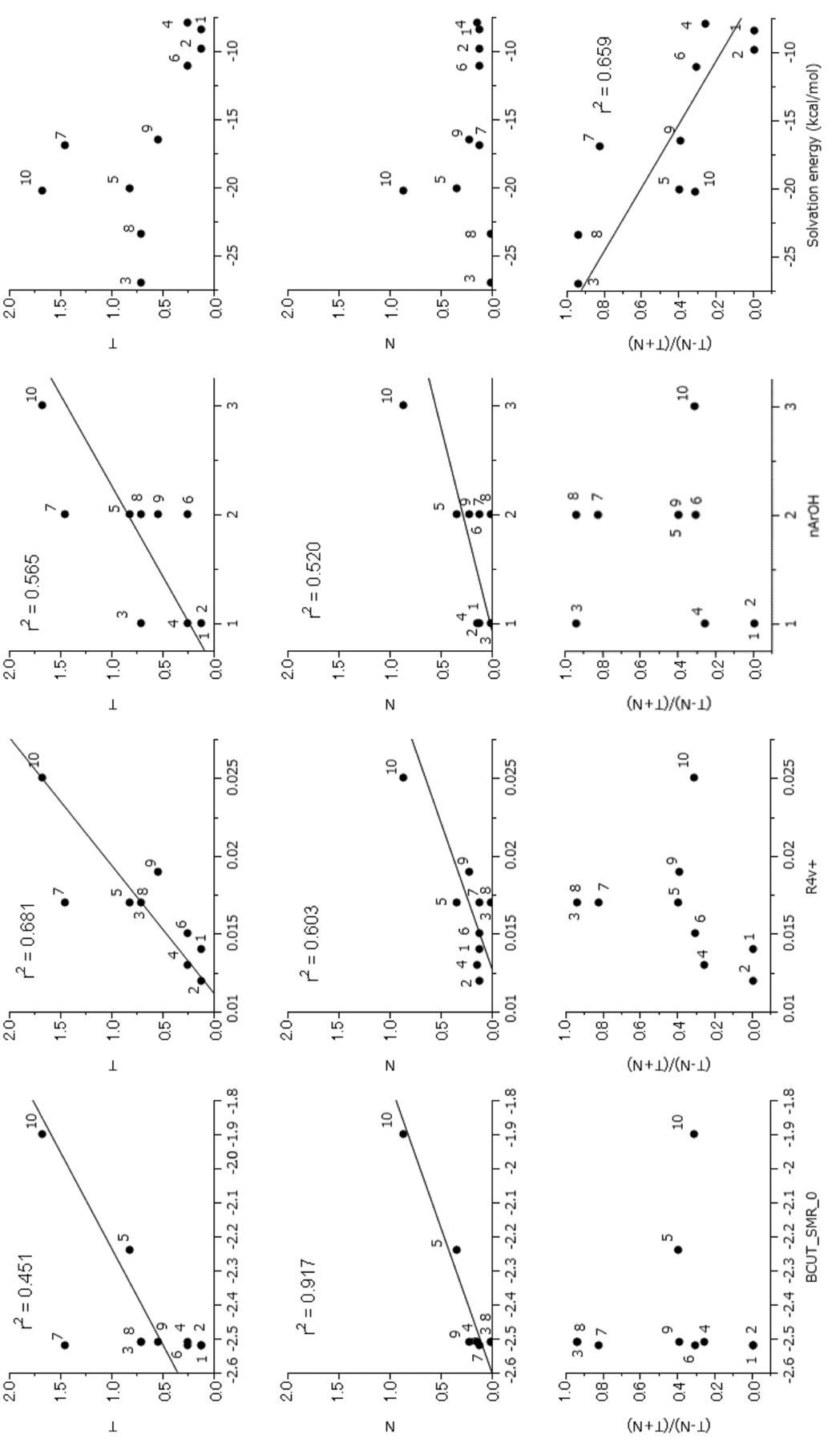
    Relationship of descriptors to cytotoxicity and to tumor-specificity index. -LogCC50 (pCC50) values were used to evaluate tumor specificity. The relationship between the tumor-specificity index (T-N)/(T+N) and each chemical descriptor was recorded, in which N and T mean average pCC50 values for normal and tumor cell lines, respectively.

Tables

  • Figures
  • Table I.
PreviousNext
Back to top

In this issue

Anticancer Research
Vol. 33, Issue 8
August 2013
  • Table of Contents
  • Table of Contents (PDF)
  • Index by author
  • Back Matter (PDF)
  • Ed Board (PDF)
  • Front Matter (PDF)
Print
Download PDF
Article Alerts
Sign In to Email Alerts with your Email Address
Email Article

Thank you for your interest in spreading the word on Anticancer Research.

NOTE: We only request your email address so that the person you are recommending the page to knows that you wanted them to see it, and that it is not junk mail. We do not capture any email address.

Enter multiple addresses on separate lines or separate them with commas.
Evaluation of Cytotoxiciy and Tumor-specificity of Licorice Flavonoids Based on Chemical Structure
(Your Name) has sent you a message from Anticancer Research
(Your Name) thought you would like to see the Anticancer Research web site.
CAPTCHA
This question is for testing whether or not you are a human visitor and to prevent automated spam submissions.
1 + 0 =
Solve this simple math problem and enter the result. E.g. for 1+3, enter 4.
Citation Tools
Evaluation of Cytotoxiciy and Tumor-specificity of Licorice Flavonoids Based on Chemical Structure
HIROKAZU OHNO, DAISUKE ARAHO, YOSHIHIRO UESAWA, HAJIME KAGAYA, MARIKO ISHIHARA, HIROSHI SAKAGAMI, MASAJI YAMAMOTO
Anticancer Research Aug 2013, 33 (8) 3061-3068;

Citation Manager Formats

  • BibTeX
  • Bookends
  • EasyBib
  • EndNote (tagged)
  • EndNote 8 (xml)
  • Medlars
  • Mendeley
  • Papers
  • RefWorks Tagged
  • Ref Manager
  • RIS
  • Zotero
Reprints and Permissions
Share
Evaluation of Cytotoxiciy and Tumor-specificity of Licorice Flavonoids Based on Chemical Structure
HIROKAZU OHNO, DAISUKE ARAHO, YOSHIHIRO UESAWA, HAJIME KAGAYA, MARIKO ISHIHARA, HIROSHI SAKAGAMI, MASAJI YAMAMOTO
Anticancer Research Aug 2013, 33 (8) 3061-3068;
Twitter logo Facebook logo Mendeley logo
  • Tweet Widget
  • Facebook Like
  • Google Plus One

Jump to section

  • Article
    • Abstract
    • Materials and Methods
    • Results
    • Discussion
    • References
  • Figures & Data
  • Info & Metrics
  • PDF

Related Articles

Cited By...

  • Antiviral and Antitumor Activity of Licorice Root Extracts
  • Quantitative Structure-cytotoxicity Relationship of 3-Benzylidenechromanones
  • Quantitative Structure-Cytotoxicity Relationship of Oleoylamides
  • Quantitative Structure-Cytotoxicity Relationship of 3-Styryl-2H-chromenes
  • Quantitative Structure-Cytotoxicity Relationship of 3-Styrylchromones
  • Quantitative Structure-Cytotoxicity Relationship of Piperic Acid Amides
  • Quantitative Structure-Cytotoxicity Relationship of Phenylpropanoid Amides
  • Google Scholar

More in this TOC Section

  • Musashi1 Enhances Cell Growth and Increases Chemoresistance in Neuroblastoma
  • 6-O-Carboxypropyl-α-Tocotrienol Enhances the Anticancer Effects of Bortezomib Without Suppressing NRF1 and NRF3 in Colorectal Cancer Cells
  • Imbalance Between CD44 and STAT3 Enhances Spheroid Viability and Impairs Pembrolizumab Response in Urothelial Cancer
Show more Experimental Studies

Keywords

  • Licorice flavonoids
  • QSAR
  • cytotoxicity
  • tumor-specificity index
  • chemical descriptor
Anticancer Research

© 2026 Anticancer Research

Powered by HighWire