Main menu

  • Home
  • Current Issue
  • Archive
  • Info for
    • Authors
    • Editorial Policies
    • Subscribers
    • Advertisers
    • Editorial Board
    • Special Issues 2025
  • Journal Metrics
  • Other Publications
    • In Vivo
    • Cancer Genomics & Proteomics
    • Cancer Diagnosis & Prognosis
  • More
    • IIAR
    • Conferences
    • 2008 Nobel Laureates
  • About Us
    • General Policy
    • Contact
  • Other Publications
    • Anticancer Research
    • In Vivo
    • Cancer Genomics & Proteomics

User menu

  • Register
  • Subscribe
  • My alerts
  • Log in
  • My Cart

Search

  • Advanced search
Anticancer Research
  • Other Publications
    • Anticancer Research
    • In Vivo
    • Cancer Genomics & Proteomics
  • Register
  • Subscribe
  • My alerts
  • Log in
  • My Cart
Anticancer Research

Advanced Search

  • Home
  • Current Issue
  • Archive
  • Info for
    • Authors
    • Editorial Policies
    • Subscribers
    • Advertisers
    • Editorial Board
    • Special Issues 2025
  • Journal Metrics
  • Other Publications
    • In Vivo
    • Cancer Genomics & Proteomics
    • Cancer Diagnosis & Prognosis
  • More
    • IIAR
    • Conferences
    • 2008 Nobel Laureates
  • About Us
    • General Policy
    • Contact
  • Visit us on Facebook
  • Follow us on Linkedin
Research ArticleClinical Studies

Primary Vesical Clear Cell Adenocarcinoma Arising in Endometriosis: A Rare Case of Mullerian Origin

KEVIN LAH, DEVANG DESAI, PAUL HADWAY, JOANNA PERRY-KEENE and GEOFF COUGHLIN
Anticancer Research February 2013, 33 (2) 615-617;
KEVIN LAH
Royal Brisbane and Women's Hospital, Herston, Brisbane, Australia
  • Find this author on Google Scholar
  • Find this author on PubMed
  • Search for this author on this site
  • For correspondence: kevinlah{at}hotmail.com
DEVANG DESAI
Royal Brisbane and Women's Hospital, Herston, Brisbane, Australia
  • Find this author on Google Scholar
  • Find this author on PubMed
  • Search for this author on this site
PAUL HADWAY
Royal Brisbane and Women's Hospital, Herston, Brisbane, Australia
  • Find this author on Google Scholar
  • Find this author on PubMed
  • Search for this author on this site
JOANNA PERRY-KEENE
Royal Brisbane and Women's Hospital, Herston, Brisbane, Australia
  • Find this author on Google Scholar
  • Find this author on PubMed
  • Search for this author on this site
GEOFF COUGHLIN
Royal Brisbane and Women's Hospital, Herston, Brisbane, Australia
  • Find this author on Google Scholar
  • Find this author on PubMed
  • Search for this author on this site
  • Article
  • Figures & Data
  • Info & Metrics
  • PDF
Loading

Abstract

Clear cell adenocarcinoma arising out of endometriosis of the urinary bladder is a rare entity. The published literature has a dearth of information about this entity and its histogenesis. In the present case review we present a 59-year-old patient who was treated with robotic anterior pelvic exenteration and ileal conduit. The initial biopsy of bladder tumour purported a high-grade urothelial carcinoma, however the final specimen revealed a clear cell adenocarcinoma arising in endometriosis without any urothelial cancer. Early case reports refer to these lesions as mesonephric or mesonephroid adenocarcinomas but the current WHO nomenclature classifies them under non-urothelial epithelial neoplasms as clear cell adenocarcinomas. Here, we review the literature and discuss their origins.

  • Clear cell adenocarcinoma
  • endometrial neoplasm
  • bladder tumor
  • pelvic exenteration
  • Mullerian tumour

Clear cell adenocarcinoma arising out of endometriosis of the urinary bladder is a rare entity. The published literature has a dearth of information about this entity and its histogenesis. Here we present a case of a 59-year-old female who was treated with robotic anterior pelvic exenteration and ileal conduit.

Report

A 59-year-old female was referred from her general practitioner to a tertiary urological clinic for management of a 7-year history of intermittent hematuria. Associated symptoms included abdominal pain “like period pain”, as reported by the patient. She was 10 years post-menopausal and medical history included hypercholesterolemia, two caesarian sections, 30 years previously, and tubal ligation. Physical examination was unremarkable. Urinary cytology showed atypical urothelial cells. Otherwise the blood results were all unremarkable.

Ultrasound showed a large mass of 36×24×28 mm on the superior bladder wall with normal upper tracts. Subsequent computed tomography scan of abdomen confirmed this mass and excluded evidence of any extravesicular spread or metastasis. Based on these findings, the patient underwent cystoscopy and transurethral resection of the bladder tumour. Endoscopic findings were suggestive of muscle invasive disease. A high-grade urothelial carcinoma with extensive (almost 100%) glandular differentiation and stromal invasion was diagnosed from the biopsy specimen (Figure 1).

Based on these findings, the patient was offered neoadjuvant chemotherapy with 2 cycles of cisplatin (Day 1; 1600 mg) and gemcitabine (Day 1, 8, 15; 124 mg) prior to robotic-assisted anterior pelvic exenteration and pelvic lymph node dissection with ileal conduit formation. Further staging with chest x-ray and bone scan was negative for metastasis.

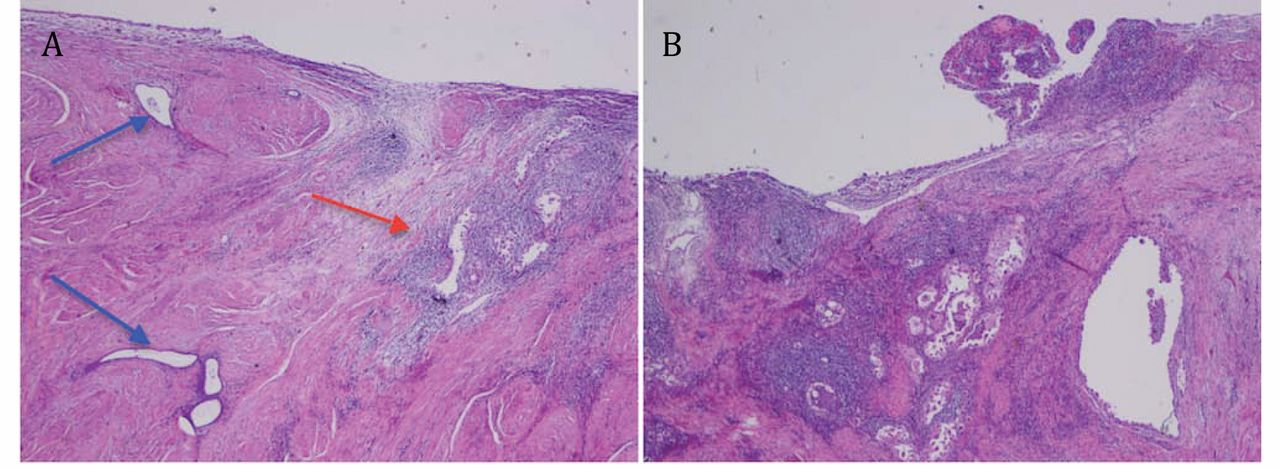
Interestingly, the definitive resection pelvic exenteration specimen revealed the true nature of the carcinoma: clear cell adenocarcinoma arising in endometriosis invading the outer half of the muscularis propria (Figure 2). There was no lymphovascular invasion, the margins were clear and 20 lymph nodes were identified as being negative for disease. There was no evidence of any primary urothelial malignancy. Medical Oncology consult was sought and the patient was given 3 cycles of adjuvant carboplatin (Day 1; 520 mg) and paclitaxel (Day 1, 8, 15; 138 mg).

There is no evidence of recurrence or metastasis after 12 months of follow-up.

Discussion

Similarly to our case, most published literature describes this condition almost exclusively in females and usually in their fifties or sixties (1). The majority of cases develop in association with urethral diverticula, but rare cases appear primarily in the bladder itself.

Although clear cell carcinoma of the lower urinary tract has been also described rarely in men, and in age ranges between 19 and 80 years, this group is heterogeneous and most represent clear cell change in otherwise typical urothelial carcinomas.
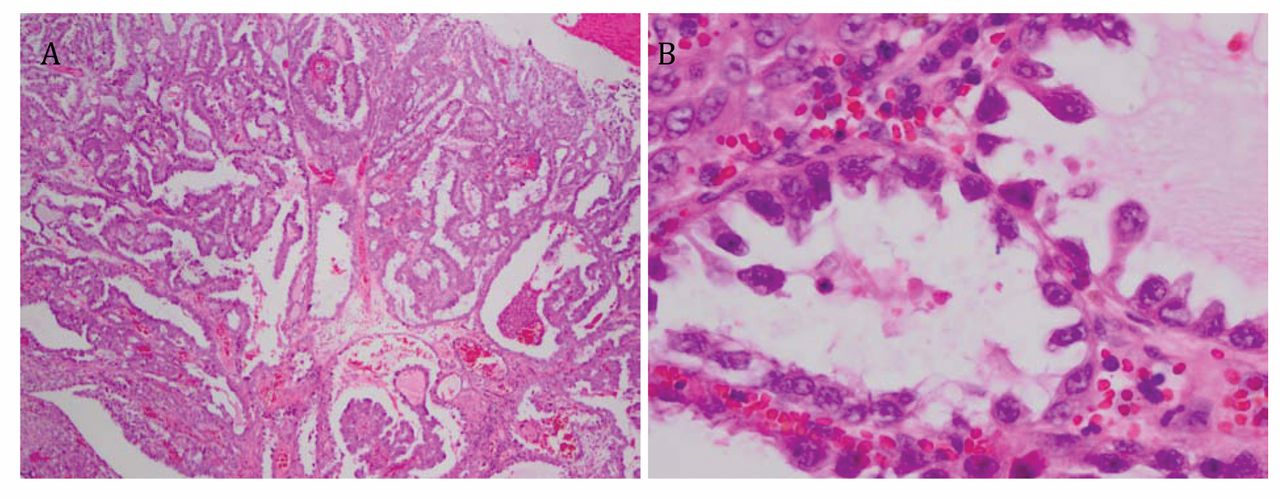
Figure 1.
  • Download figure
  • Open in new tab
  • Download powerpoint
Figure 1.

Hematoxylin and eosin stain of the bladder biopsy showing the papillary architecture with hobnail cells. (A: ×40, B: ×100).

Figure 2.
  • Download figure
  • Open in new tab
  • Download powerpoint
Figure 2.

Hematoxylin and eosin stain of cystectomy specimen. A: Blue arrows: endometriosis, red arrow: cancer. B: Residual papillary surface and invasive components. (A & B ×40).

Early case reports refer to these lesions as mesonephric or mesonephroid adenocarcinomas but the current WHO nomenclature classifies them under non-urothelial epithelial neoplasms, as clear cell adenocarcinomas (2). The published literature mainly focuses on theories of origin of these tumours – mesonephric or Mullerian. Tumours were found at the bladder neck, urethra, and posterior wall, and usually with a co-existing component of urothelial cancer (3).

In our case, the lesion was located on the postero-superior wall in a focus of endometriosis, without the presence of any primary urothelial cancer.

The theory of Mullerian origin is favoured based on three factors: its morphological similarity to tumours of this lineage within the female genital tract, that the tumours are largely found in women, and its frequent association with endometriosis (4). Immunohistochemical analysis of tumour samples does not reliably distinguish tumour origin, so it has been assumed that the embryonic origin varies with each case (5).

From a histological perspective, it is also important to consider benign clear cell lesions such as nephrogenic adenoma in the differential diagnosis (6). Both clear cell carcinoma and nephrogenic adenoma are well-characterised from a morphological viewpoint (7). Nevertheless, both are reported to express paired box gene-8, which can help differentiate less classical lesions from urothelial carcinoma (8).

Most patients undergo cystectomy as the only treatment. Only one case of radiotherapy treatment alone has been described, resulting in complete response of the localised disease (9).

Experience with chemotherapy is limited to an adjuvant setting. The drugs used include cisplatin and 5-fluorouracil 1, carboplatin and methotrexate (10), and adriamycin and cyclophosphamide (11), with or without radiotherapy.

Our patient had neoadjuvant and adjuvant chemotherapy along with robotic anterior pelvic exenteration and ileal conduit formation.

Conclusion

To out knowledge, this is the first case of this condition treated with robotic surgery following neoadjuvant chemotherapy. Endometriosis was co-located with the carcinoma and was also present at the aspect of the uterus. In our patient, there was no demonstrable urothelial malignancy in the final histology, indicating a Mullerian origin for this particular case.

  • Received December 4, 2012.
  • Revision received January 15, 2013.
  • Accepted January 15, 2013.
  • Copyright© 2013 International Institute of Anticancer Research (Dr. John G. Delinassios), All rights reserved

References

  1. ↵
    1. Kurosaka S,
    2. Irie A,
    3. Mizoguchi H,
    4. Okuno N,
    5. Iwabuchi K,
    6. Baba S
    : Advanced clear-cell adenocarcinoma of the bladder successfully treated by radical surgery with adjuvant chemoradiotherapy. Int J Clin Oncol 10: 362-365, 2005.
    OpenUrlPubMed
  2. ↵
    1. Kleihues P,
    2. Sobin LH
    1. Tavassoli FA,
    2. Devilee P
    : Pathology and Genetics of Tumours of the Breast and Female Genital Organs. In: World Health Organization Classification of Tumours (Kleihues P, Sobin LH (eds.). Lyon, IARC Press., pp. 225-226, 2003.
  3. ↵
    1. Butterworth DM,
    2. Haboubi NY,
    3. Lupton EW
    : Mixed mesonephric adenocarcinoma and transitional cell carcinoma of the bladder. Histopathology 16: 601-604, 1990.
    OpenUrlPubMed
  4. ↵
    1. Chor PJ,
    2. Gaum LD,
    3. Young RH
    : Clear cell adenocarcinoma of the urinary bladder: Report of a case of probable Mullerian origin. Mod Pathol 6: 225-228, 1993.
    OpenUrlCrossRefPubMed
  5. ↵
    1. Oliva E,
    2. Amin MB,
    3. Jimenez R,
    4. Young RH
    : Clear cell carcinoma of the urinary bladder: A report and comparison of four tumors of Mullerian origin and nine of probable urothelial origin with discussion of histogenesis and diagnostic problems. Am J Surg Pathol 26: 190-197, 2002.
    OpenUrlCrossRefPubMed
  6. ↵
    1. Gilcrease MZ,
    2. Delgado R,
    3. Vuitch F,
    4. Albores-Saavedra J
    : Clear cell adenocarcinoma and nephrogenic adenoma of the urethra and urinary bladder: A histopathologic and immunohistochemical comparison. Hum Pathol 29: 1451-1456, 1998.
    OpenUrlCrossRefPubMed
  7. ↵
    1. Doria MI Jr..,
    2. Saint Martin G,
    3. Wang HH,
    4. Blumstein A,
    5. Jensen JA,
    6. Maslan AM,
    7. Gattuso P
    : Cytologic features of clear cell carcinoma of the urethra and urinary bladder. Diagn Cytopathol 14: 150-154, 1996.
    OpenUrlPubMed
  8. ↵
    1. Tong GX,
    2. Weeden EM,
    3. Hamele-Bena D,
    4. Huan Y,
    5. Unger P,
    6. Memeo L,
    7. O'Toole K
    : Expression of PAX8 in nephrogenic adenoma and clear cell adenocarcinoma of the lower urinary tract: Evidence of related histogenesis? Am J Surg Pathol 32: 1380-1387, 2008.
    OpenUrlCrossRefPubMed
  9. ↵
    1. Pegoraro V,
    2. Cosciani Cunico S,
    3. Graziotti PP,
    4. Dalla Palma P
    : Mesonephric adenocarcinoma of the bladder. Urologie 88: 531-532, 1982.
    OpenUrl
  10. ↵
    1. Doddamani D,
    2. Ansari MS,
    3. Gupta NP,
    4. Aron M,
    5. Singh I,
    6. Gupta SD
    : Mesonephroid adenocarcinoma of the bladder and urethra: A case report. Int Urogynecol J Pelvic Floor Dysfunc 13: 47-49, 2002.
    OpenUrl
  11. ↵
    1. Honda N,
    2. Yamada Y,
    3. Nanaura H,
    4. Fukatsu H,
    5. Nonomura H,
    6. Hatano Y
    : Mesonephric adenocarcinoma of the urinary bladder: A case report. Acta Urol Jpn 46: 27-31, 2000.
    OpenUrl
PreviousNext
Back to top

In this issue

Anticancer Research
Vol. 33, Issue 2
February 2013
  • Table of Contents
  • Table of Contents (PDF)
  • Index by author
  • Back Matter (PDF)
  • Ed Board (PDF)
  • Front Matter (PDF)
Print
Download PDF
Article Alerts
Sign In to Email Alerts with your Email Address
Email Article

Thank you for your interest in spreading the word on Anticancer Research.

NOTE: We only request your email address so that the person you are recommending the page to knows that you wanted them to see it, and that it is not junk mail. We do not capture any email address.

Enter multiple addresses on separate lines or separate them with commas.
Primary Vesical Clear Cell Adenocarcinoma Arising in Endometriosis: A Rare Case of Mullerian Origin
(Your Name) has sent you a message from Anticancer Research
(Your Name) thought you would like to see the Anticancer Research web site.
CAPTCHA
This question is for testing whether or not you are a human visitor and to prevent automated spam submissions.
10 + 1 =
Solve this simple math problem and enter the result. E.g. for 1+3, enter 4.
Citation Tools
Primary Vesical Clear Cell Adenocarcinoma Arising in Endometriosis: A Rare Case of Mullerian Origin
KEVIN LAH, DEVANG DESAI, PAUL HADWAY, JOANNA PERRY-KEENE, GEOFF COUGHLIN
Anticancer Research Feb 2013, 33 (2) 615-617;

Citation Manager Formats

  • BibTeX
  • Bookends
  • EasyBib
  • EndNote (tagged)
  • EndNote 8 (xml)
  • Medlars
  • Mendeley
  • Papers
  • RefWorks Tagged
  • Ref Manager
  • RIS
  • Zotero
Reprints and Permissions
Share
Primary Vesical Clear Cell Adenocarcinoma Arising in Endometriosis: A Rare Case of Mullerian Origin
KEVIN LAH, DEVANG DESAI, PAUL HADWAY, JOANNA PERRY-KEENE, GEOFF COUGHLIN
Anticancer Research Feb 2013, 33 (2) 615-617;
Twitter logo Facebook logo Mendeley logo
  • Tweet Widget
  • Facebook Like
  • Google Plus One

Jump to section

  • Article
    • Abstract
    • Report
    • Discussion
    • Conclusion
    • References
  • Figures & Data
  • Info & Metrics
  • PDF

Related Articles

  • No related articles found.
  • PubMed
  • Google Scholar

Cited By...

  • Endometriosis-associated Extraovarian Malignancies: A Challenging Question for the Clinician and the Pathologist
  • Google Scholar

More in this TOC Section

  • The Posterior First Approach in Robot-assisted Radical Prostatectomy for Prostate Cancer Reduces Positive Surgical Margins on the Bladder Neck Side
  • Gamma Knife Radiotherapy of Brain Metastasis Resection Cavities: Outcome Analysis of a Single-center Cohort
  • Efficacy and Safety of Chemoimmunotherapy in Patients With Advanced Non-small Cell Lung Cancer With Pre-existing Interstitial Pneumonia and Low PD-L1 Expression
Show more Clinical Studies

Similar Articles

Keywords

  • Clear cell adenocarcinoma
  • endometrial neoplasm
  • bladder tumor
  • Pelvic exenteration
  • Mullerian tumour
Anticancer Research

© 2025 Anticancer Research

Powered by HighWire