Abstract
Background: Albendazole (ABZ) is a microtubule depolymerizing agent with a remarkable activity against a variety of tumor cells in vitro and in vivo. However, the lack of water solubility limits its application. Therefore, the aim of this study was to formulate ABZ with acetic acid/2-hydroxypropyl-β-cyclodextrin (HPβCD) with the view of improving its aqueous solubility and therefore, its antitumor efficacy. Materials and Methods: ABZ was dissolved in acetic acid and 25% HPβCD (w/v). Mice received a single dose of ABZ/HPβCD or a conventional suspension in hydroxypropyl methyl cellulose (HPMC) over 24 h and the concentration of ABZ and its metabolites in plasma were measured by HPLC. The antitumor efficacy of the two formulations were then evaluated and compared in nude mice bearing HCT-116 colorectal cancer xenografts. Results: Ionization with acetic acid together with complexation with hydroxylpropyl-β-cyclodextrin (HPβCD) dramatically improved the solubility of ABZ. The area under the curve (AUC) of ABZ and its active metabolite, ABZ sulfoxide (ABZSO) were approximately 2.3- and 7.3-folds higher in mice that received ABZ/HPβCD in comparison with animals that were treated with ABZ/HPMC. Additionally, the peak plasma concentration (Cmax) of ABZSO was nearly 18-times higher in mice that received ABZ/HPβCD. Furthermore, a significant delay in tumor growth that led to longer survival in mice was observed in the ABZ/HPβCD-treated group as compared to the ABZ/HPMC group. Conclusion: These findings demonstrate that the combination of acetic acid and HPβCD significantly improves the solubility, pharmacokinetic profile and antitumor efficacy of ABZ. This newly-developed formulation of ABZ may be suitable for parenteral administration.
Albendazole (ABZ) is a member of the benzimidazole (BZ) family of compounds with a broad spectrum of activity on human and animal helminth parasites (1). Being a tubulin-binding agent, ABZ has also displayed remarkable activity on a number of tumor cells. We have previously demonstrated that ABZ inhibited the proliferation of human hepatocellular carcinoma and colorectal cancer cells both in vitro and in vivo (2, 3). In addition, in a human ovarian carcinoma xenograft model, intraperitoneal administration of ABZ suppressed the formation of malignant ascites and inhibited the expression of vascular endothelial growth factor (VEGF) (4), a key mediator of angiogenesis.
Despite its efficacy, the clinical usefulness of ABZ is hampered by its poor oral bioavailability. ABZ has a very low water solubility (0.2 μg/ml), allowing its preparation only as a suspension (5). This suspension formulation has poor gastrointestinal absorption and displays high inter-individual variation in absorption and elimination (6). In recent years, numerous attempts have been made to improve ABZ solubility and thereby, enhance its efficacy. These include the use of soybean oil emulsion (7), surfactants (8), liposomes (9), polyvinylpyrrolidone (10, 11), ionization in acids (12-14), complexation with cyclodextrins (CDs) (5, 15), or a combination of these methods (16-18).
ABZ is a basic drug with pKa values of 2.8 and 10.28 (19). Therefore, in acidic medium ABZ is in its ionized form. Theoretically, drugs with a basic group in their structure can be solubilized in acidic medium providing that the pKa of the drug is above the pKa of the formulation (20). On the other hand, heterocyclic and aromatic rings in the chemical structure of ABZ make it an ideal candidate for complexation with CDs. CDs are cyclic oligosaccharides composed of α-1-4-linked glucose units (21) which are extensively used to increase the solubility, safety, and stability of compounds (22). In aqueous solutions, CDs form inclusion complex with drugs by taking up the drug molecule into their lipophilic inner cavity (21). The most commonly used CDs are α-CD, β-CD, and γ-CD, consisting of six, seven, and eight glucopyranose residues, respectively (23). Hydroxypropyl-β-cyclodextrin (HPβCD) is a derivative of β-CD with improved water solubility and safety, compared with its parent compound (24). In a study carried out by our group, we showed that the complexation with HPβCD increased the solubility and the cytotoxic effect of ABZ against ovarian cancer cells (25).
In the current study, the pharmacokinetic behavior of ABZ solution in HPβCD/acetic acid and this of ABZ suspension in HPMC, was compared. Furthermore, the antitumor activity of the two formulations was evaluated both in vitro and in vivo. To our knowledge, this study is the first to report the antitumor efficacy of ABZ/HPβCD in an animal model.
Materials and Methods
Chemicals. ABZ, acetic acid, sodium hydroxide, HPMC, and Sulforhodamine B (SRB) were purchased from Sigma (Australia). HPβCD was supplied by Cyclodextrin Technologies Development, Inc. (CTD; Florida, USA). ABZSO and ABZSO2 were obtained from GlaxoSmithKline.
Drug preparation. 0.5 ml of glacial acetic acid were added to 30 mg ABZ and the mixture was vortexed vigorously until ABZ was completely dissolved. The solution was then added to 13.5 ml HPβCD (25% w/v in dH2O) and the pH was adjusted to 7.4 by addition of sodium hydroxide (NaOH). The solution was homogenous and no precipitation was observed.
To prepare the suspension formulation, ABZ was suspended in sterile 0.9% sodium chloride containing 0.5% (w/v) HPMC, yielding a final concentration of 3 mg/ml. Another suspension formulation was prepared in water in order to compare the solubility of ABZ in HPMC and HPβCD with its solubility in water. Both suspension formulations were stirred for 24 h at room temperature. The three preparations were then filtered through a 0.2-μm filter membrane and assayed for ABZ contents by HPLC.
Cell culture. HCT-116 human colorectal cancer cell line and DU145 prostate cancer cells were maintained in RPMI-1640 (Invitrogen), supplemented with 10% heat-inactivated fetal bovine serum (FBS; Sigma-Aldrich), 50 units/ml penicillin, and 50 units/ml streptomycin (Gibco, Invitrogen). Human Umbilical Vein Endothelial Cells (HUVECs; Invitrogen) were grown in a 1:1 mixture of M199 (Sigma) and endothelial cell growth medium (EGM BulletKit; Lonza Australia Pty Ltd.), supplemented with 10% FBS, bovine brain extract, heparin, human endothelial growth factor (hEGF), hydrocortisone, gentamicin, and amphotericin B. The cells were incubated at 37°C in a 5% CO2 humidified incubator.
Cell proliferation assay. Cytotoxicity of ABZ dissolved in ethanol was compared to ABZ formulated in HPβCD and HPMC in DU-145, HCT-116, and HUVEC cell lines. In addition, the toxicity of the drug-free HPβCD and HPMC solutions (vehicle) were assessed. A cell proliferation assay was performed in 96-well microtiter plates using the Sulforhodamine B (SRB) colorimetric assay (26). Briefly, HCT-116, DU145, and HUVEC cells were seeded at a density of 2500, 3500, and 3000 cells/well, respectively, in triplicate and allowed to attach for 24 h. Cells were then incubated with various concentrations of the drugs and vehicles. After 72 h, cells were fixed with 10% ice-cold trichloroacetic acid for 30 min followed by five washes with tap water. Cells were then stained for 15 min with 0.4% (w/v) SRB dissolved in 1% acetic acid, and washed with 1% acetic acid. The plates were allowed to dry and SRB dye was dissolved in 10 mM Tris base (pH 7.4). Optical density (OD) values were determined at 570 nm.
Mice. Ten-week-old female nude mice were obtained from the Animal Resources Centre (Perth, Australia) and housed in a pathogen-free environment for one week before the commencement of experiments. All experiments were conducted according to the protocols approved by the Animal Experimentation Ethics Committee of the University of New South Wales. At the end of the experiment, mice were euthanized by an overdose of pentobarbital.
Pharmacokinetic study. Seventy-two mice were divided into fourteen groups of 5 animals and one group of two animals. Six groups received a single dose of ABZ/HPβCD and a similar group of mice were administered ABZ/HPMC. Out of the two remaining groups, one received the vehicle of ABZ/HPβCD and the other received the vehicle of ABZ/HPMC. Two mice received no treatment (blank). The drugs were given intraperitoneally at a dose of 50 mg/kg. Treated animals were euthanized at ½, 1, 2, 4, 8, and 24 h post-drug administration and vehicle groups were euthanized 2 h after treatment. Blood samples were taken by cardiac puncture and the samples were centrifuged at 5000 ×g for 10 min at 4°C. Plasma samples were stored at −80°C for HPLC analysis.
HPLC analysis. The Shimadzu HPLC system used, consisted of a LC-20AD Pump, a SIL-20A autosampler, a CBM-20A system controller and a RF-10AXL fluorescence detector. The chromatography was carried out using a Phenomenex Luna C18 column (3 μm, 150 × 3 mm). Mobile phase A contained 15% acetonitrile, 0.01 M phosphoric acid, 5 mM tetrabutylammonium hydrogen sulfate and 85% water (v/v/w/v). Mobile phase B consisted of 30% acetonitrile, 0.01 M phosphoric acid, 5 mM tetrabutylammonium hydrogen sulfate and 70% water (v/v/w/v). A gradient mobile phase was initiated with 100% mobile phase A using a linear gradient to mobile phase B at 3.01 min. The gradient remained constant for 4 min at which time, it was changed linearly to mobile phase A at 7.01 min until the end of the run. The run time for each sample was 15 min and the flow rate was 1.0 ml/min. Under these conditions, retention times of ABZSO, ABZSO2, and ABZ were 6.1, 9.3, and 10.6 min respectively. All data were recorded and analyzed using the Class-VP Chromatography Data System Software.
HPLC standards and quality controls. The concentrations of the stock solutions were 100 μg/ml, 500 μg/ml and 1 mg/ml for ABZSO, 10 μg/ml, 100 μg/ml and 1 mg/ml for ABZSO2 and 10 μg/ml and 100 μg/ml for ABZ. Working standard solutions were prepared in human plasma at the concentrations of 0.1, 0.5, 1, 10, 25 and 50 μg/ml for ABZSO, 0.05, 0.5, 1, 5, 10, 25 and 50 μg/ml for ABZSO2 and 0.01, 0.05, 0.1, 0.2, 0.5, 1, and 2 μg/ml for ABZ. Samples with concentrations greater than the highest standards were diluted or re-injected at lower volumes. Calibration curves were prepared with each set of sample. To ensure that the method is accurate and precise, quality control samples (QCs) for intra- and inter-day assays were analyzed with each run. The QC samples were prepared in human plasma at concentrations of 0.2, 2.5 and 40 μg/ml for ABZSO, 0.1, 2.5 and 40 μg/ml for ABZSO2 and 0.02, 0.15 and 1.5 μg/ml for ABZ. Precision and accuracy were evaluated by analyzing the standard curves and three samples at each concentration level (low, medium and high) for each metabolite. In order to assess the precision of the method, the coefficient of variation of each tested concentration was calculated. To determine the accuracy of the method, the measured concentration of each QC was compared with its nominal values.
Precision and accuracy of ABZ, ABZSO and ABZSO2 in human plasma.
Plasma extraction. 100 μl of sodium metabisulfate and 3 ml ethyl acetate were added to 150 μl of plasma. After brief vortexing, the samples were mixed for 20 min and the tubes were centrifuged at 1800 rpm for 5 min. Supernatants were then transferred to new tubes and evaporated to dryness using a thermo savant rotary vacuum chamber consisting of SC210A Speed Vac Plus, RVT4140 Refrigerated Vapor Trap and VLP200 ValuPump (Thermo Electron Corporation, Melbourne, Australia). The extracts were resuspended in 200 μl of mobile phase containing 15% acetonitrile, 0.01 M phosphoric acid and 5 mM tetrabutylammonium hydrogen sulfate.
In vivo tumor growth assessment. HCT-116 cells were harvested using 1% trypsin-EDTA (Invitrogen, Australia) and a single-cell suspension of 2×10⁶ cells in 0.1 ml of matrigel (Sigma, Australia) was injected subcutaneously into the hind leg of the animals. When the tumors had grown to approximately 100 mm3, mice were randomized into three groups of 8 animals. Group 1 received ABZ/HPβCD vehicle, group 2 animals were treated with 50 mg/kg ABZ/HPβCD, and group 3 animals were administered 150 mg/kg ABZ/HPMC. All groups received the treatment intraperitoneally every second day. Tumor dimension was measured every three days and the tumor volume was calculated using the formula: (shortest diameter)2 × longest diameter × 0.5. Animals were euthanized when the tumor size reached 1000 mm3.
Toxicity evaluation. In an initial pilot study, 10 mice were administered with 5, 10, 25, 40, and 50 mg/kg ABZ/HPβCD for 28 consecutive days. In addition, 4 animals received the drug-free vehicles of 50 and 60 mg/kg ABZ/HPβCD. The body weight and general clinical status of the animals were recorded daily and considered as a surrogate for evaluation of general wellbeing.
Statistical analysis. Data are presented as the mean±SEM. All statistical analyses were performed using the GraphPad Prism software package version 5.0 (GraphPad Software Inc., San Diego, CA, USA). The survival days were determined with the Kaplan-Meier plots and compared by the log-rank test. p-Values <0.05 were considered to be significant. Differences between groups were evaluated using the Student's t-test and one-way ANOVA.
Results
HPLC analysis.
Standards and calibration curves. This method was developed to separate ABZSO from an inactive metabolite of ABZ, albendazole 2-aminosulfone (ABZ-NH2). The retention times for ABZSO, ABZSO2 and ABZ were 6.1, 9.3 and 10.6 min, respectively, and no interfering peak was detected in blank plasma. The accuracy of the assay was determined by calibration curves of ABZSO, ABZSO2, and ABZ. Peak areas of ABZ and its metabolites were found to increase linearly at drug concentrations between 0.5-50, 0.5-50, and 0.1-2 for ABZSO, ABZSO2, and ABZ, respectively.
Validation of the method. The precision of the method was evaluated using the coefficient of variation for each sample (CV). The accuracy was calculated by comparison between the actual value of the QCs and the values which were determined by the method. The low QCs of ABZ and its metabolite were undetectable, suggesting that the low QCs were below the limit of quantification (LOQ).
Intra- and inter-day accuracy and precision for ABZ and its metabolites are summarized in Table I. The intra-day precision ranged from 3.573% to 6.085% and the inter-day precision ranged from 4.363% to 11.627%. Intra-day and inter-day accuracy were within the 15% from the true values.
Solubility of ABZ. ABZ contents in three formulations of ABZ were measured by HPLC. The solubility of ABZ in HPβCD/acetic acid, HPMC, and dH2O were 1970±140 μg/ml, 210±30 μg/ml, and 0.19±0.08 μg/ml, respectively. The solubility of ABZ in HPβCD/acetic acid was approximately 10-times higher, compared to that in HPMC.
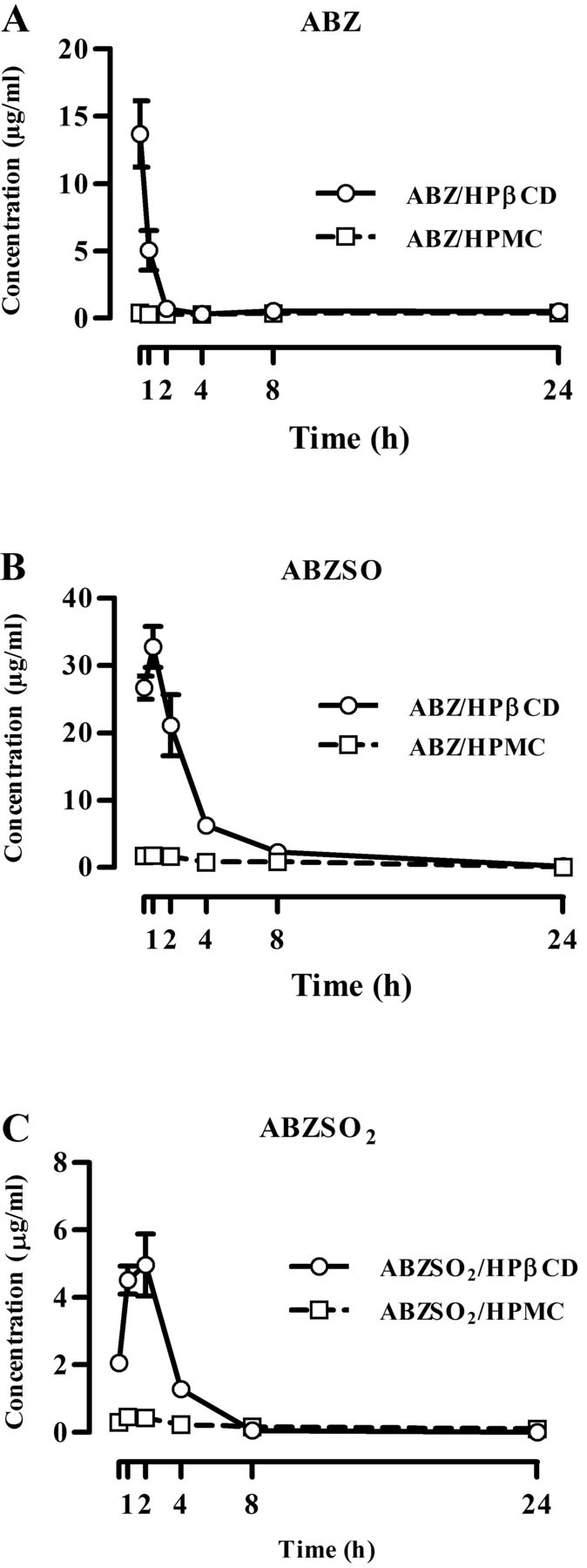
Pharmacokinetics of ABZ/HPβCD and ABZ/HPMC. After intraperitoneal administration of the drugs, the peak plasma concentration (Cmax) of ABZ in animals that received ABZ/HPβCD and ABZ/HPMC, were 13.7 μg/ml and 0.36 μg/ml, respectively, indicating a 38-fold higher concentration of the parent drug in plasma of mice that were treated with ABZ/HPβCD, compared to animals that received an equivalent dose of ABZ/HPMC. ABZ was cleared from plasma within 2 h of administration, demonstrating a rapid metabolism of the parent drug to its active metabolite, ABZSO. The peak plasma concentrations (Cmax) of ABZSO for both formulations were detected at 1 h post-administration (Tmax). Cmax ABZSO were 32.7 and 1.8 μg/ml for ABZ/HPβCD and ABZ/HPMC, respectively, which gradually declined after 7 h and reached undetectable levels within 24 h. Animals that received ABZ/HPβCD exhibited a delayed time to reach peak concentration of ABZSO2, suggesting that the oxidation of ABZSO to its inactive metabolite is slower in animals that were administered with ABZ/HPβCD compared to those that were treated with ABZ/HPMC.
Area under the concentration-time curve (AUC) of ABZ and its metabolites within 24 h post-administration were calculated using the Prism software. As shown in Table II, a higher AUC was obtained after treatment with ABZ/HPβCD compared to ABZ/HPMC. Animals that received ABZ/HPβCD represented an approximately 2.3-, 7.3- and 3.8-fold increase in AUC values of ABZ, ABZSO, and ABZSO2, respectively, compared to mice that received ABZ/HPMC.
Figure 1 shows the mean concentration-time profiles of ABZ and its metabolites following the administration of 50 mg/kg ABZ/HPMC and ABZ/HPβCD. The pharmacokinetic parameters for ABZ/HPMC and ABZ/HPβCD are summarized in Table II.
Comparison of the effect of ABZ/ethanol, ABZ/HPβCD and ABZ/HPMC on cell proliferation. Anti-proliferative effects of ABZ formulated in HPβCD and HPMC and ABZ dissolved in ethanol (ABZ/EtOH) were tested against HCT-116, DU145, and HUVECs cell lines. Cells were incubated with various concentrations of ABZ/HPβCD and ABZ/HPMC ranging from 0.01 to 100 μM. To ascertain whether HPβCD and HPMC had an effect on cell viability, cytotoxicity of drug-free vehicles were also evaluated. The stock solution of ABZ/EtOH was 1 mM and the concentrations of 0.01 to 10 μM were used. Since concentrations greater than 1% ethanol are toxic to cells, the highest concentration of ABZ/EtOH was 10 μM.
Pharmacokinetic parameters of ABZ, ABZSO and ABZSO2 following intraperitoneal administration of a single dose of 50 mg/kg ABZ/HPMC and ABZ/HPβCD.
As shown in Figure 2, all tested formulations represented a dose-dependent toxicity against HCT-116, DU145, and HUVECs cell lines. The IC50 value of ABZ/HPβCD in HCT-116 was slightly lower than that of ABZ/EtOH (0.37 μM versus 0.5 μM, respectively). Similar to HCT-116 cells, in HUVECs, ABZ/HPβCD represented a lower IC50 compared with ABZ/EtOH (0.26 μM versus and 0.3 μM, respectively). However, the differences were not statistically significant (p>0.05). In DU145 cells, both ABZ/HPβCD and ABZ/EtOH had an IC50 value of 0.6 μM.
In all tested cell lines the IC50 values of ABZ/HPMC were significantly higher than ABZ/HPβCD. In HCT-116 cells, the IC50 of ABZ/HPMC was 4.8 μM, indicating a 13-fold increase in the cytotoxicity of ABZ/HPβCD compared with ABZ/HPMC (Figure 2A). Similar results were obtained with DU145 cells (Figure 2B) and HUVECs (Figure 2C). In comparison to ABZ/HPβCD, an approximately 9- and 12-fold increase in cell death after treatment with ABZ/HPβCD was observed in DU145 cells and HUVECs, respectively. The IC50 values of ABZ/HPMC against DU145 and HUVECs were 5.5 μM and 3.1 μM, respectively. Treatment of the cells with drug-free vehicles at concentrations corresponding to the drugs had no cytotoxic effect.
Antitumor efficacy. To determine whether increased plasma concentration of ABZ/HPβCD also led to increased antitumor efficacy, the effect of ABZ/HPβCD and ABZ/HPMC therapy on survival of mice-bearing HCT-116 tumors was compared. According to previous studies, alternate-day intraperitoneal dosing of 150 mg/kg ABZ/HPMC was the most effective dosing schedule (2, 3). Thus, for antitumor efficacy experiment, the effect of 150 mg/kg ABZ/HPMC was compared with 50 mg/kg ABZ/HPβCD.
As depicted in Figure 3, treatment with both ABZ/HPβCD and ABZ/HPMC prolonged the survival of animals compared to that of vehicle-treated mice, with 50 mg/kg ABZ/HPβCD being superior to 150 mg/kg ABZ/HPMC. ABZ/HPMC treatment showed a median survival time of 31 days as opposed to mice from the control group, which had a survival time of 23 days (p=0.02). Treatment with ABZ/HPβCD resulted in a significant increase in the survival of the mice (41.5 days), compared with ABZ/HPMC therapy (p=0.03).
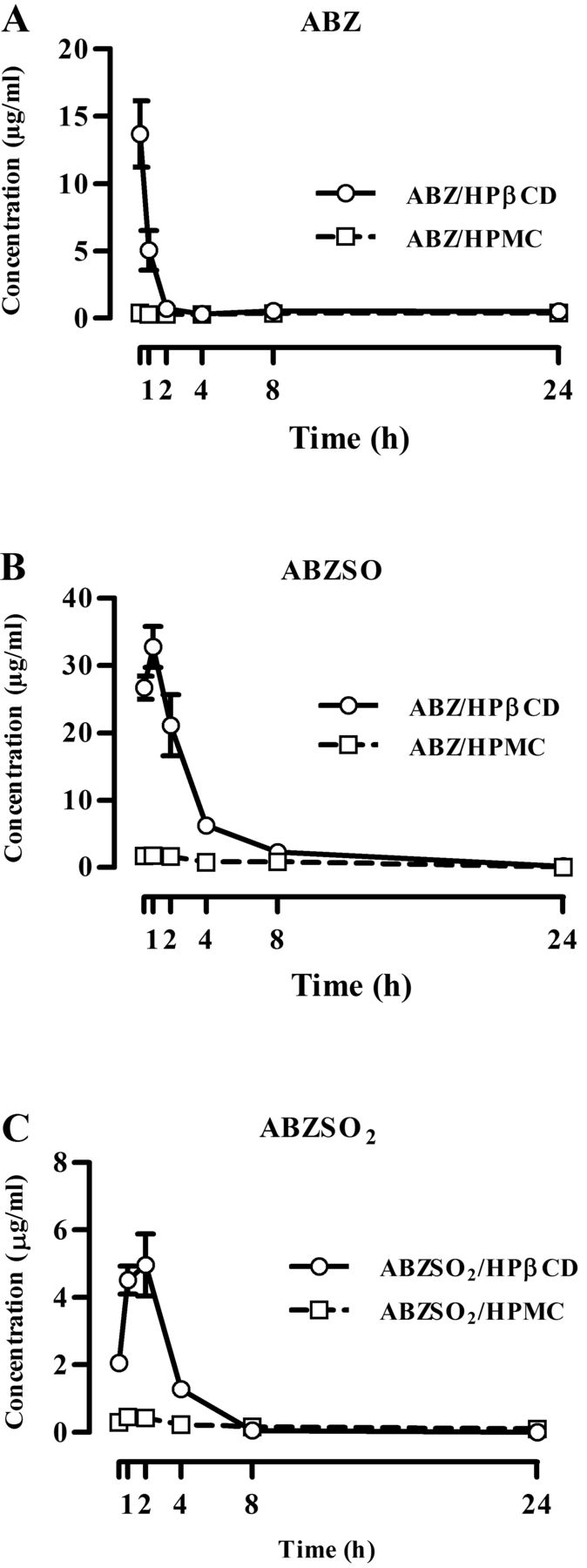
Mean plasma concentration of ABZ (A), ABZSO (B), and ABZSO2 (C) following the administration of ABZ/HPMC and ABZ/HPβCD. Error bars indicate SEM.
Toxicity evaluation. ABZ Solution containing more than 0.5 ml/kg acetic acid and/or 1 ml/kg sodium hydroxide was found to be toxic to the animals. Thus, the highest concentration of the drug that was administered to the animals was 50 mg/kg. Following a single intraperitoneal dose of 60 mg/kg ABZ/HPβCD, mice lost mobility and were euthanized within 2 h. Other treatment regimens had no adverse effect on animal wellbeing. However, following the dose of 40 mg/kg ABZ/HPβCD, a 15% reduction in the weight of the animals was observed which was recovered after 72 h (Figure 4).
Discussion
The aim of this study was to compare the pharmacokinetic profiles of ABZ/HPβCD with a conventional suspension formulation of ABZ in ABZ/HPMC. In addition, the in vitro anti-proliferative effect of the two formulations as well as their in vivo antitumor activity were evaluated.
Pharmacokinetic studies revealed that the AUCs of ABZ, ABZSO, and ABZSO2 in the plasma of animals that received ABZ/HPβCD were approximately 2.3-, 7.3-, and 3.8-folds greater than in mice that were given a corresponding dose of ABZ/HPMC. Furthermore, the peak plasma concentrations (Cmax) of ABZ, ABZSO, and ABZSO2 in ABZ/HPβCD-treated mice were found to be 34-, 18-, and 11-times higher than in ABZ/HPMC-treated animals. These results are consistent with other studies reporting that the use of the combination of acid and CD profoundly enhanced the bioavailability of ABZ, compared with the conventional formulation (1, 16-18, 28, 29).
Comparison between the cytotoxic effect of the two formulations in HCT-116, DU145, and HUVECs cells demonstrated that ABZ/HPβCD was approximately 13-, 9-, and 12-times more potent in inhibiting the growth of the cells than ABZ/HPMC. These differences were solely attributed to the solubility of ABZ in HPβCD, as no significant difference between the IC50 values of ABZ/EtOH and ABZ/HPβCD was observed.
Consistent with the in vitro results, treatment with 50 mg/kg ABZ/HPβCD led to a significant increase in the survival time of mice, compared to that of 150 mg/kg ABZ/HPMC. Enhanced efficacy of ABZ/HPβCD seems to be due to the increased aqueous solubility and absorption of the drug, as soluble drug molecules can extravasate from leaky tumor vasculature and accumulate in the tumor tissue, due to the absence of an effective lymphatic drainage (27). The improved therapeutic effect of ABZ/HPβCD can be also attributed to the higher plasma levels of ABZSO in mice that received ABZ/HPβCD which led to increased AUCs of ABZ, and its metabolites for ABZ/HPβCD compared with ABZ/HPMC. It is conceivable that higher AUC may correlate with higher exposure of the tumor to the drug and therefore, greater efficacy of the drug. Another possible reason for the higher efficacy of ABZ/HPβCD may probably be due to the delayed oxidation of ABZSO, a pharmacologically active metabolite, to the inactive form, ABZSO2.

Cytotoxic effects of ABZ/HPβCD, ABZ/HPMC and ABZ/EtOH on HCT-116 (A), DU145 (B) and HUVECs (C) cell lines. Cells were exposed to indicated concentrations of the drugs for 72 h. The results from three separate experiments are represented as mean±SEM.

In vivo response of HCT-116 xenografts to ABZ/HPβCD and ABZ/HPMC. Mice were inoculated with 2×10⁶ HCT-116 cells. When the tumor size reached approximately 100 mm3, animals were treated with the vehicle, 50 mg/kg ABZ/HPβCD, and 150 mg/kg ABZ/HPMC. Mice were euthanized when the tumor size reached 1000 mm3.
In addition to the higher solubility and improved pharmacokinetic parameters of ABZ, as a result of the complexation with HPβCD, the possible effect of HPβCD on the pharmacokinetic behavior of ABZ and therefore, its therapeutic effect should also be considered. HPβCD is known to be an efficient carrier for drugs as they are able to pass through the vascular endothelium (28). In addition, CDs have been shown to affect the interaction between the drug molecules and plasma proteins (29). However, this effect is dependent on the stability constant between the drug and CD, as well as the relative affinity of the drug to the plasma proteins. ABZ has been shown to have a moderate plasma protein binding of 70% (6) and its stability constant with HPβCD is within the optimum margin of 200-5000 M−1 (30). This stability constant and the moderate affinity of ABZ towards plasma proteins may reduce the binding of ABZ to plasma proteins. Since only the unbound fraction of the drugs have pharmacological effect, even a slight reduction in protein binding of ABZ may have a significant effect.

Effect of different concentrations of ABZ/HPβCD on body weight. Mice were treated with ABZ/HPβCD for 28 consecutive days.
For the pharmacokinetic study, both ABZ/HPβCD and ABZ/HPMC were administered at a dosage of 50 mg/kg. This dose was chosen based on the toxicity profile of ABZ/HPβCD, as doses above 50 mg/kg are toxic to the animals. Indeed, mice receiving an intraperitoneal dose of 60 mg/kg ABZ/HPβCD were euthanized within 2 h post-administration. Signs of poisoning, apparent 20 min after administration were sedation and convulsion. This toxic effect was due to the vehicle, as drug-free vehicle caused the same effect in the animals. Since intraperitoneal administration of up to 10 mg/kg HPβCD is neither lethal nor toxic to mice (24), the observed toxic effect was attributed to exceeding the LD50 of acetic acid and/or sodium hydroxide. ABZ/HPMC dose for antitumor experiment was selected according to the previous in vivo experiments in which it was demonstrated that 150 mg/kg ABZ had a significant antitumor effect with no adverse impact on animals' wellbeing (2, 3).
In summary, the results show that the solubility of ABZ was highly improved by complexation with acetic acid/HPβCD. Indeed, a 10,000-fold increase in aqueous solubility of the drug was achieved. Moreover, ABZ/HPβCD exhibited significantly greater antitumor efficacy and higher plasma AUC and Cmax in comparison with ABZ/HPMC. These findings lead to the conclusion that the formulation may be suitable for parenteral administration.
- Received June 11, 2012.
- Accepted July 13, 2012.
- Copyright© 2012 International Institute of Anticancer Research (Dr. John G. Delinassios), All rights reserved