


Abstract
Background: In the present study, the effect of immunochemotherapy with lentinan compared with that of chemotherapy alone was evaluated in patients with advanced gastric cancer through individual patient data (IPD) meta-analysis. Materials and Methods: Based on a computerized and manual search, all eligible centrally randomized controlled trials (RCT) which compared chemotherapy regimens with or without lentinan administration for advanced gastric cancer patients were included. Results: In total, 650 IPD from 5 trials were available. Lentinan significantly prolonged the overall survival (stratified log-rank p=0.011). The overall hazard ratio (HR) was 0.80 (95% confidence interval=0.68-0.95) and there was no heterogeneity between trials. Additionally, lentinan was possibly more effective in patients with lymph-node metastasis than in non-node metastasis patients (P for interaction=0.077). Conclusion: The addition of lentinan to standard chemotherapy offers a significant advantage over chemotherapy alone in terms of survival for patients with advanced gastric cancer.
The per annum incidence and mortality of gastric cancer are estimated at about 930,000 and 700,000 gastric cancer patients in the world (1). Although both incidence and mortality have decreased in developed countries, it ranks as the second most common cause of cancer mortality worldwide and remains a significant problem in global health terms. In particular, advanced/recurrent gastric cancer, especially that deemed to be inoperable, remains an incurable disease. Several drugs and combinations of chemotherapy have been investigated, but response rates and 5-year survival rates of patients have not been markedly improved (2-5).
Biological response modifiers (BRMs) are widely used with cytotoxic agents for gastric cancer therapy. BRMs stimulate the immune system to reject and destroy tumors and such immunochemotherapy is expected to exert a synergistic effect. In adjuvant settings, the benefit of immuno-chemotherapy using polysaccharide K (PSK) has been shown in one randomized clinical trial and through meta-analysis involving 8,009 patients from eight randomized controlled trials (RCT) (6, 7). Similarly, Sakamoto et al. conducted a meta-analysis involving 1,522 patients from six clinical trials of immunochemotherapy with penicillin-killed lyophilized Streptococcus pyogenes (OK-432) and suggested that OK-432 may improve the survival of patients with curatively resected gastric cancer (8). However, the beneficial effects for patients with advanced/recurrent gastric cancer are still unclear. Popiela et al. explored the survival prolonging effect of Bacillus Calmette-Guérin (BCG) and 5-fluorourinated pyrimidine (5-FU) compared with 5-FU alone or surgery alone over 20 years ago, but there was no significant difference in patients with non-resectable tumors after 2-year follow-up (9).
Lentinan, which is a purified polysaccharide isolated from Lentinus edodes, has been shown to have some antitumor activity (10, 11). In Japan, lentinan is clinically administered to patients with unresectable advanced gastric cancer, and post-operative gastric cancer patients with recurrent disease, usually in combination with tegafur (T). However, there is insufficient evidence from large RCTs to recommend immunochemotherapy with lentinan in patients with unresectable/recurrent gastric cancer. In the present study, an individual patient data (IPD) meta-analysis was conducted with the aim of evaluating the effect of immunochemotherapy with lentinan compared with that of chemotherapy alone for patients with advanced unresectable/recurrent gastric cancer.
Materials and Methods
Search strategy. A computerized and manual search of the electronic databases Medline and PubMed and the Japanese Ichu-shi was performed to identify all RCT of Lentinan used for unresectable/recurrent gastric cancer patients. The same search strategy for RCT of unresectable/recurrent gastric cancer as the Cochrane Review (4), which is a combination of medical subject headings (MeSH) and text words, was used, and additionally used the MeSH and text words related to the use of immunochemotherapy with lentinan were included. Review papers were also examined for published results. Duplication of data was avoided by examining the body of each publication or the names of all the authors. To ensure that all relevant studies were included, enquiries were made of the researchers with area expertise about the possible existence of unpublished trials. The following eligibility criteria for the target trials were used. i) The study was aimed at the evaluation of the survival effect of chemotherapy regimen with or without lentinan administration for advanced unresectable or recurrent gastric cancer patients. ii) It was a central RCT (including trials using envelope methods). iii) A control arm received the same chemotherapy as the therapeutic arm. iv) The trial was concluded before the end of 2007. After the identification of eligible trials, the collaboration of the relevant investigators in this meta-analysis and the provision of the latest version of the IPD were requested.
Statistical analysis. The primary analysis included all the available IPD of the eligible trials. Overall survival was analyzed through a stratified two-sided log-rank test, with trial as the stratification factor. In addition, the hazard ratio (HR) and 95% confidence interval (CI) were calculated as the measure for assessing the survival benefits of lentinan from Cox's proportional hazard model stratified by trials. If data on important prognostic factors were available, multiple Cox's proportional hazard model was used to check whether the estimates of treatment effects changed after adjustment for these factors. A forest plot of the HRs was produced for overall survival. Subgroup analyses were also performed according to meaningful patient characteristics, with an interaction test to assess the statistical significance of any observed differences between the treatment effects in different subgroups.
A HR of less than 1.0 indicates a beneficial effect of immunochemotherapy and a ratio equal to or more than 1.0 is thought to demonstrate a harmful effect. The analysis was based on the intention-to-treat principle and defined a statistical test result with a two-sided p-value less than 0.05 was defined as significant. SAS version 9.1 (SAS Institute Inc., Cary, NC, USA) was used for all the analyses.
Results
Trial screening. Figure 1 shows the flow diagram through the stages of the meta-analysis. In total, forty references were identified as potentially relevant to the study (8 references from Medline and PubMed, 31 references from Japanese database (Ichu-shi), and one reference from handsearching of review papers and queries from the researchers with area expertise). After excluding review references as well as duplicate publications, 15 potential relevant references remained for further evaluation (12-26).
Two trials out of 15 references were excluded because functional food containing superfine lentinan and not the pure drug was used (12, 13). In addition, three trials were not RCTs (14, 15, 23) and one trial evaluated the effect of lentinan on mice (25). After detailed evaluation, nine references met the eligibility criteria. Since Taguchi evaluated two RCTs using different regimens (T plus lentinan or not, and 5-FU+mitomycin plus lentinan or not) in one reference (24), they were considered as different trials. In the potentially eligible 10 RCTs, 650 IPD (68.2%) were acquired out of 953 patients' data from five trials (19, 20, 24, 26) and IPD were not obtained from five trials because the data were discarded (16-18, 21, 22). The five trials from which IPD were received were labeled as the Chiba study (19), the Hokkaido study (20), the FT study (24), the MF study (24), and the Tohoku study (26).

Flow diagram through the stages of the meta-analysis. *One reference (25) included 2 trials. RCT, Randomized controlled trial; IPD, individual patient data. pts, patients.
Trial and patient characteristics. Table I shows the eligible trial and patient characteristics for the IPD meta-analysis. All the trials used regimens based on the combination of fluorinated pyrimidines and Lentinan. The FT, MF and Tohoku studies were conducted in the early 80's and the others were in the late 80's. There was little difference about the baseline characteristics between the studies, but the Hokkaido study mostly enrolled non-recurrent patients and surgery was conducted in all the patients in the study. In addition, patients did not undergo surgery in the Tohoku study. For all the available IPD, the proportion of hepatic metastasis in the chemotherapy plus Lentinan group was smaller than the chemotherapy alone group (34.5% vs. 43.1%), but the other factors balanced well between the two groups.
Treatment effect of lentinan on the overall survival. Two hundred and eighty patients (82.6%) and 262 patients (84.2%) died during 6.0 months of median follow-up in the chemotherapy plus lentinan and the chemotherapy alone groups, respectively. The Kaplan-Meier curve is depicted in Figure 2. The median survival time (MST) was 139 days in the chemotherapy plus lentinan group and 114 days in the chemotherapy alone group. The combination of chemotherapy based on mainly fluorinated pyrimidines and lentinan statistically significantly prolonged the overall survival (stratified log-rank p-value=0.011). The overall HR was 0.80 (95% CI=0.68-0.95) and there was no heterogeneity between trials (heterogeneity p-value=0.466, Figure 3). The HR adjusted by trial and nine baseline characteristics (age, sex, performance status (≥2 or not), recurrent, prior therapy, surgery, peritoneal metastasis, hepatic metastasis, lymph-node metastasis) was 0.76 (95% CI=0.64-0.90; p=0.002).
Trial and patient characteristics for the IPD meta-analysis.
Table II shows the baseline characteristics and the results in each reference whose IPD were not available. Most of the trials were conducted in the late '80s. The baseline characteristics were slightly different between the eligible trials with available IPD and those without available IPD, but the MST of the immunochemotherapy group also seemed to be longer than that of the chemotherapy group in the latter trials. This trend for the beneficial effect of lentinan was the same as the primary results based on the IPD meta-analysis.
Subgroup analysis was conducted based on six baseline characteristics (age less than 65 or not, gender, recurrent or inoperable advanced gastric cancer, peritoneal metastasis, hepatic metastasis, lymph node metastasis). Figure 4 shows the HRs and corresponding 95% CI. There was no significant interaction, but the immunochemotherapy was probably more effective in the patients with lymph node metastasis than in those without (p-value for interaction=0.077).
Some hematological and nonhematological adverse events were reported in the two treatment regimens (19 leucopenia (5.6%), 32 thrombocytopenia (9.4%), 13 anorexia (3.8%) and 6 nausea (1.8%) in the immunochemotherapy with lentinan; 5 leucopenia (1.6%), 45 thrombocytopenia (14.5%), 13 anorexia (4.2%) and 6 nausea (1.9%) in the chemotherapy alone), but none of them were severe and all were reversible and manageable.

Kaplan-Meier curve of overall survival. MST, median survival time.
Discussion
Out of the ten RCTs conducted to date, the FT and MF studies were relatively large, but most were of small sample size and those could not conclude whether the immunochemotherapy with lentinan in comparison with chemotherapy alone was beneficial or not. The present IPD meta-analysis of the 650 patients' data showed that the combination immunotherapy of fluorinated pyrimidines and lentinan had a modest, but significant overall survival benefit for patients with advanced, unresectable or recurrent gastric cancer. Since IPD meta-analysis provides one of the highest levels of evidence, this result is meaningful for the future treatment development for advanced gastric cancer.
Recently, two phase III trials of S-1, which is composed of T, gimestat and otastat potassium in a molar ratio of 1:0.4:1, in patients with advanced gastric cancer have been reported from Japan. In JCOG 9912, the combination of irinotecan and cisplatin was not better than 5-FU alone, but S-1 was no worse than 5-FU (MST of the S-1 arm was reported as 11.4 months) (27). The SPIRIT trial showed that the MST of S-1 plus cisplatin (13·0 months) was significantly longer than that of S-1 alone (11·0 months) (28). In response to these results, S-1 or the combination of S-1 and cisplatin seem to be the standard treatment for advanced gastric cancer especially in Eastern countries. If S-1 becomes a standard treatment in the advanced setting, it would be interesting to confirm the synergistic effect of lentinan with S-1. Nimura et al. reported a preliminary result that the MST for the immunochemotherapy combination with S-1 and lentinan reached 559 days for 32 unresected/recurrent advanced gastric cancer patients in a phase II study (14). Oka et al. are conducting a phase III trial to investigate the superiority of a combination of S-1 and lentinan compared to S-1 alone in advanced or recurrent gastric cancer in (29) and this is the focus of considerable interest.
The present meta-analysis also showed that immunochemotherapy with lentinan may be especially effective in patients with lymph node metastasis. The immunesuppressed status of patients with advanced cancer has been reported (30). It is still unclear, but BRMs such as lentinan or PSK are considered to alter the immunological background and activate cytotoxic effector cells or helper cells in patients with far advanced cancer (31). The antitumor immune reactivity is especially suppressed in patients with lymph node metastasis, which might link to the present results of that subgroup.
Some limitations of the present IPD meta-analysis must be mentioned. First, while over two-thirds of IPD were collected for this meta-analysis, 303 patients' data unfortunately could not be retrieved because the data were discarded. It is possible that collected data were biased. However, the results shown in the papers of the uncollected data did not differ from the present primary results, which means that the uncollected data would not have changed the conclusion. Second, the randomization methods were most envelope methods. The envelope randomization methods have generally proven to be somewhat problematic in several respects. The major problem is that participating physicians may have sometimes violated and interfered with the randomization process, especially in the studies started during the early 1980s. However, the important prognostic factors were adjusted using the multiple Cox proportional hazard model. The adjusted HR was 0.76 (95% CI=0.64-0.90; p=0.002) and this was consistent with the primary result. IPD meta-analysis could possibly minimize the bias caused by envelope methods. Finally, the proportion of hepatic metastasis in the chemotherapy plus lentinan group was smaller than in the chemotherapy alone group (34.5% vs. 43.1%). However, the result was not changed after adjustment using the multiple Cox regression analysis, thus it was considered that this difference between treatment groups did not influence the conclusion.
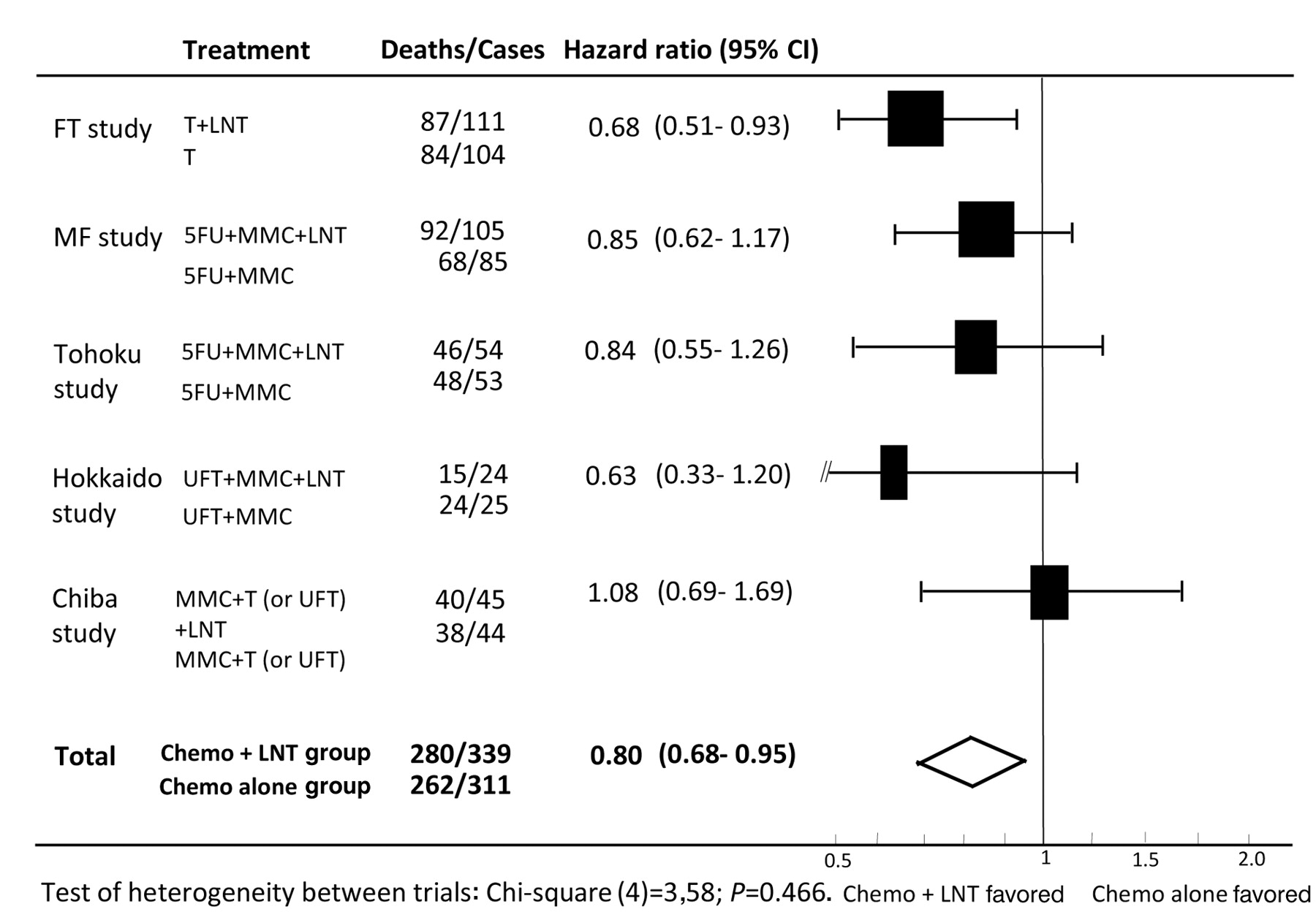
Forest plot of hazard ratios and corresponding 95% confidence intervals. LNT, Lentinan; MMC, mitomycin C; T, tegafur; 5-FU, 5-fluorinated pyrimidine; UFT, tegafur-uracil.

Subgroup analysis based on 6 baseline characteristics. LNT, Lentinan; MMC, mitomycin C; T, tegafur; 5-FU, 5-fluorinated pyrimidine; Pmeta, peritoneal metastasis; Hmeta, hepatic metastasis; Nmeta, lymph-node metastasis.
Patient characteristics and results in each reference whose IPD were not available.
In conclusion, the addition of lentinan to standard chemotherapy offers a significant advantage over chemotherapy alone in terms of survival for patients with advanced, unresected/recurrent gastric cancer. It is hoped these results will result in wider acceptance of immunochemotherapy for the treatment of advanced gastric cancer.
- Received December 10, 2008.
- Revision received February 17, 2009.
- Accepted March 23, 2009.
- Copyright© 2009 International Institute of Anticancer Research (Dr. John G. Delinassios), All rights reserved
References
In this issue


Jump to section
Related Articles
Cited By...
- How do tumours outside the gastrointestinal tract respond to dietary fibre supplementation?
- MPSSS impairs the immunosuppressive function of cancer-associated fibroblasts via the TLR4-NF-{kappa}B pathway
- Accelerated Wound Healing on the Skin Using a Film Dressing with {beta}-Glucan Paramylon
- The Effect of Lentinan Combination Therapy for Unresectable Advanced Gastric Cancer